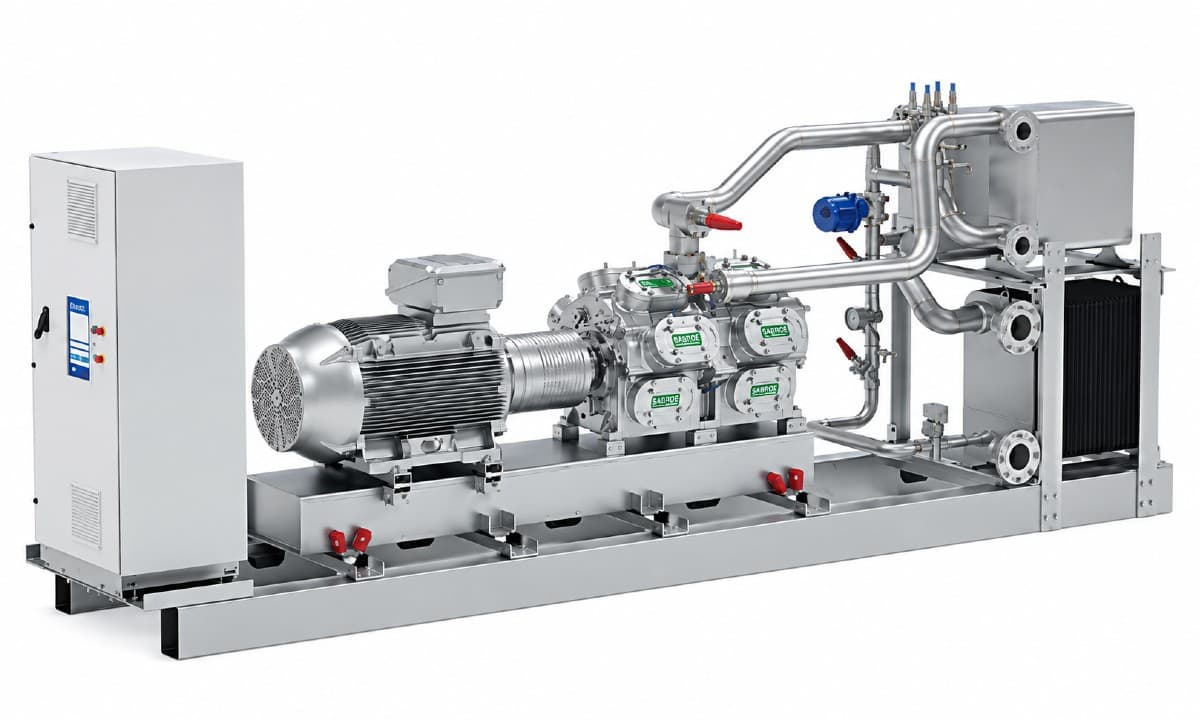
Projects reported by European suppliers indicate that high-temperature heat pumps (HTHPs) are becoming standardized for outlet temperatures of up to 130°C (266°F), with demonstrations pushing temperatures beyond 160°C (320°F), according to Martin Pihl Andersen, a consultant at the Danish Technological Institute (DTI).
Andersen outlined HTHP technology trends over the past year based on data from more than 40 projects in 14 countries during a presentation at Vahterus Heat Pump Forum 2026. The event took place June 16‒17 in Turku, Finland.
Project 68, part of the International Energy Agency (IEA)’s collaboration program on heat pump technologies, tracks supplier-reported HTHP technologies and demonstration data, including temperature limits, system capacities, refrigerants and cost indicators. The DTI is curating the public database and providing annual updates. Running from June 2025 to May 2028, Project 68 builds on Annex 58, IEA’s first HTHP database initiative.
“In Project 68 we see a refrigerant shift happening, with natural options representing 75% of the reviewed portfolio,” Andersen said. “Frequently used natural refrigerants include CO2 [R744], steam [R718], hydrocarbons and ammonia [R717] in ammonia-water systems. For every HFO HTHP, there is a natural refrigerant alternative.”
The event
ATMOsphere’s Founder and CEO, Marc Chasserot, was the keynote speaker at the Vahterus forum. He highlighted the state of clean heating and cooling, citing the company’s 2025 report, “Refrigeration: Commercial and Industrial Refrigeration with Natural Refrigerants.” The report estimates that 5,650 industrial sites in Europe use transcritical CO2 systems as of December 2025, while 4,100 use low-charge ammonia systems. ATMOsphere is the publisher of NaturalRefrigerants.com.
In addition the forum featured sessions on opportunities created by environmental targets and EU regulations, along with case studies of natural refrigerant solutions. Presentations were delivered by representatives from Vilter by Copeland, Johnson Controls, GEA, Mayekawa and Everllence (formerly MAN Energy Solutions). It also included a tour of Vahterus’s heat exchanger production facility.
Emerging trends: The HTHP data supplied by more than 55 technology providers naturally divide into three categories: standardized products with outlet temperatures of up to 130°C with capacities from 300‒1,200kW (85‒340TR); custom modular systems covering temperatures from 160‒200°C (320‒392°F) with capacities from 0.5‒10MW (142‒2,840TR); and custom steam-cycle projects with temperatures from 150‒300°C (302‒572°F) delivering capacities from 1‒100MW (284‒28,400TR).
- The standard range includes skid-sized heat pumps for district heating, with specific investment costs typically running below €600 per kW ($2,400 per TR), with relatively limited variation across projects.
- The custom modular systems often use hydrocarbon refrigerants with an extra compression stage or a cascade configuration to support up to 200°C steam at 12‒14bar (174‒203psi). Variation in specific investment costs increased with suppliers reporting between €400‒€1,300 per kW ($1,600‒$5,200 per TR).
- The upper end of the temperature range includes very large, custom steam-generation systems using Stirling-cycle concepts and dedicated steam compressors, Andersen explained. Specific investment costs range from €150‒€900 per kW ($600‒$3,600 per TR).
The applications/roadmap: Andersen outlined the industries represented in Project 68 and estimated when preferred HTHP technologies are expected to become established.
- The food and beverage industry accounted for 33% of the projects; materials applications such as drying processes, 19%; pulp and paper demonstrations, 16%; district heating applications above 100°C (212°F), 12%; chemicals and refinery, pharmaceuticals and wastewater treatment each accounted for 5%; while other uses made up the remaining 7%.
- Preferred technologies for systems operating below 120°C are already established, Andersen noted. He expects “meaningful standardization” for outputs up to 160°C within the next two to three years, followed by those operating above 160°C by the beginning of 2030.
- “For this to happen, compressor manufacturers need to validate performance and reliability at the higher discharge temperatures,” Andersen told NaturalRefrigerants.com. He also noted that stable, favorable electricity-to-gas price ratios will incentivize standardized designs.
Moving the market: “Our heat pump test center at DTI is building two compressor test rigs for what we feel the market is missing,” Andersen said.
- The SCOTTIE rig will test steam compressors at up to 23bar (334psi) of pressure with discharge temperatures up to 350°C (662°F).
- For both natural refrigerant and HFO compressors, the MARCO rig supports testing with suction pressures from 1‒15 bar (15‒218psi), discharge pressures of less than 35bar (508psi) and temperatures of up to 200°C.
- The HTHP test rig Sand Box supports plug-and-test evaluation of up to 2MW (567TR) systems, with an available electrical supply of up to 1,400A.
Quotable: “The thermodynamic and engineering groundwork for delivering industrial heat electrically at scale is largely there up to 130°C and to 160°C for some instances,” Andersen said. “What’s needed now is the accumulation of trust [through] more operating hours, transparent performance data, standardized offerings and proven integrations that reduce the perceived risk.”