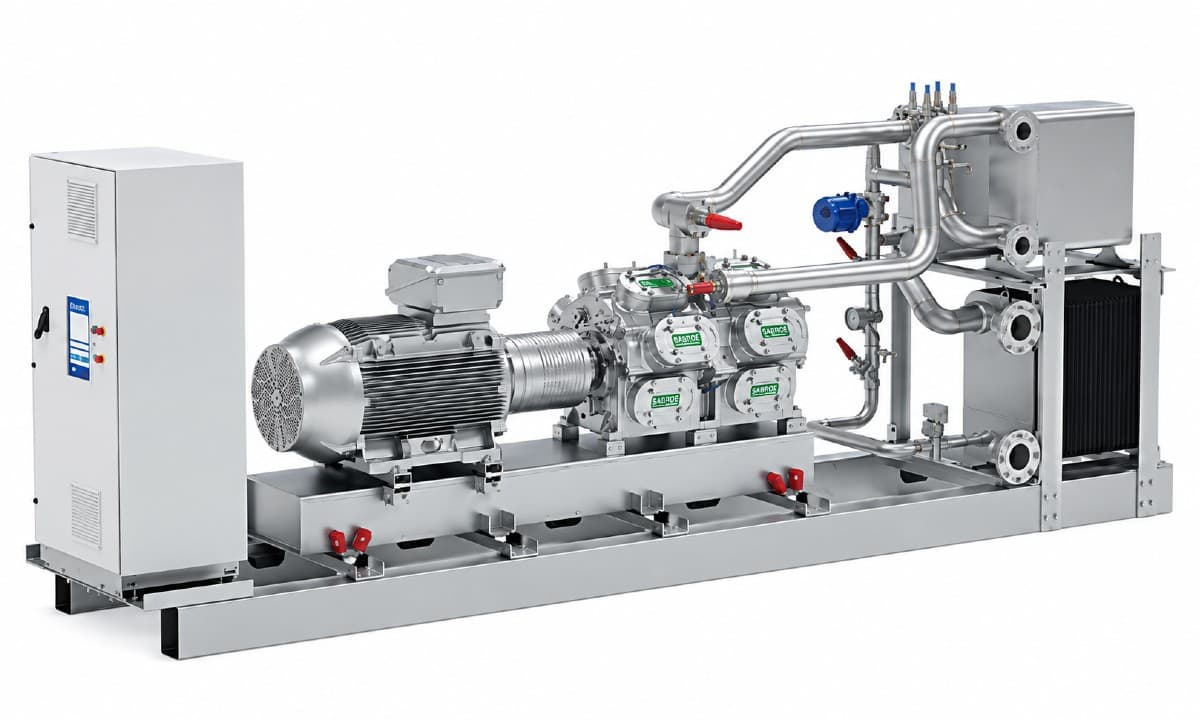
A new study has found that an ammonia-water (R717-R718) solution cross-type absorption-resorption heat transformer (ARHT) can achieve a 19% higher COP than a traditional ARHT through optimized pressure management, resulting in a gross temperature lift (GTL) of 25°C (77°F).
AHTs, also known as a “heat pump type II,” raises the temperature of a heat source to a more useful level. They are used in desalination plants, power plants and industrial drying processes. The technology can use thermal energy from industrial waste heat or renewable sources like solar or geothermal energy with minimal primary energy consumption.
ARHTs integrate resorption, which enhances efficiency by further concentrating the ammonia-water working fluid. “Cross-type” refers to the specific design of the absorption-resorption heat transformer, where the solution flow paths are configured to cross between the absorber, resorber, generator and desorber. This configuration enhances the gas-emission range of the generator and the mass transfer potential of the resorber, improving overall system performance.
Researchers established a thermodynamic model around how different parameters affect the ARHT’s COP and found that with a high/low-pressure pair of 1.5/0.48Mpa (217.5/69.6psi) and temperatures of 105°C (221°F) for the generator, 80°C (176°F) for both the absorber and resorber and 4°C (39.2°F) for the desorber, the new system’s COP can reach 0.4. This performance is 19% higher than that of traditional ARHTs.
The proposed system provides a GTL of 25°C, enabling the proposed ARHT to better use low-grade waste heat, making industrial waste heat recovery more efficient and economically viable.
The study, “Performance research of a solution cross-type absorption-resorption heat transformer using NH3/H2O work fluid,” was written by a team of researchers, including Zhili Shen from the School of Energy and Environment Southeast University and Lijie Feng from China Telecom Corporation Nanjing Branch. It was published in the journal Applied Thermal Engineering.
Optimal performance
The researchers evaluated the performance of an ammonia-water solution cross-type ARHT, examining the impact of high and low pressures on the system’s COP to determine optimal operating pressures. The researchers also compared solution concentration differences and circulation ratios across the generator, resorber, absorber and desorber. Additionally, the study evaluates the useful inputs and heat exchange within the solution heat exchanger.
In the study, the solution circulation ratio in the generator-absorber loop (fH) indicates the mass flow rate ratio of the working fluid between the generator and the absorber. In contrast, the desorber-resorber loop (fL) represents the mass flow rate ratio between the desorber and the resorber, influencing the gas-emission range and efficiency of the heat transfer process.
The study found that with a high/low-pressure pair of 1.5/0.48 MPa, the cross-type ARHT exhibits solution circulation ratios of 5.6 and 1.94, respectively. As the low-pressure increases, the ratio of fH increases while fL decreases. This occurs because the decrease in the gas-emission range in the generator and the increase in the gas-emission range in the desorber affect the circulation ratios inversely.
“A smaller solution circulation ratio in the generator-absorber loop reduces the heat consumption in the generator, thereby increasing the COP of the system,” the study explained.
System design
Single-stage ARHTs operate with a low-pressure absorber and require low-driving heat sources, limiting their performance and practicality. Cross-type ARHTs improve performance by changing the solution flow path, increasing the generator’s gas-emission range and the resorber’s mass transfer potential. This increases the system’s COP and reduces the risk of solution leakage as it operates in a closed-loop. It also eliminates the need for additional rectification processes to separate the water from ammonia vapor, which decreases the system’s cost.
“The proposed ARHT design eliminates the need for a rectifier by adjusting the solution’s mass flow rate between the absorber and the resorber,” the study said. “This adjustment balances the concentrations of the working fluid, allowing the system to operate more efficiently under various conditions.”
Moreover, the new ARHT system operates over various temperatures and requires lower optimal low-pressure values. These features make it suitable for applications involving large pressure differences, such as industrial waste heat recovery and chemical processing.
“The proposed ARHT design eliminates the need for a rectifier by adjusting the solution’s mass flow rate between the absorber and the resorber. This adjustment balances the concentrations of the working fluid, allowing the system to operate more efficiently under various conditions.”
Zhili Shen et al.