Enex Releases 2025 Sustainability Report
Enex has released its 2025 Sustainability Report, with the company noting that last year, 55% of its revenue came from natural refrigerant-based HVAC&R products. Its goal is to increase that figure to 76% by 2028. Enex also said that its sale of natural refrigerant products that year reduced customer emissions by 238,000 tCO2e (tons of CO2 equivalent) and that it delivered 1,400 hours of total training to customers, distributors and agents.
Fenagy and SCM Frigo See ‘Record-High Growth’
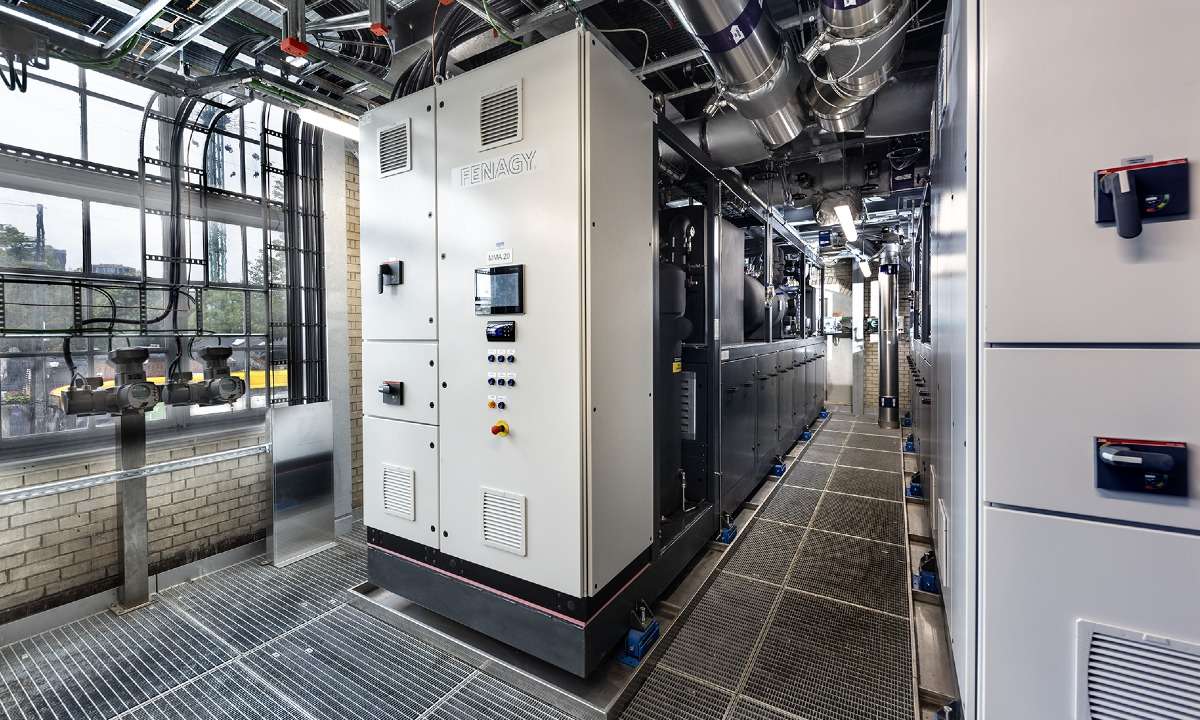
Beijer Ref has released its 2026 second quarter financial report, and the parent company of Fenagy and SCM Frigo noted that both companies saw “record-high growth” during the period. Beijer Ref said Fenagy and SCM Frigo were the driving factors behind its 5% underlying organic growth during the quarter. Fenagy was lauded for seeing its “highest ever order intake in a single quarter” while SCM Frigo “continued to deliver particularly strong results in Australia.”
Rivacold Provides 1.6MW CO2 Refrigeration System for Italian Logistics Center
Rivacold has provided a 1.6MW (1,706TR) transcritical CO2 (R744) refrigeration system for a logistics center in Massalengo, Italy. The system provides 800kW (227TR) of low-temperature capacity at -35°C (-31°F) and 880kW (250TR) of medium-temperature capacity at -5°C (23°F). The system can operate in ambient temperatures up to 36°C (96°F) and provides refrigeration for a total of eight storage rooms.
Frauenhofer ISE Develops R290 Heat Pump Concepts for Multi-Family Homes
German research institute Fraunhofer ISE has published new findings from its LC R290 research project, which consist of several propane (R290) heat pump concepts for multi-family buildings. Fraunhofer worked with German housing companies on the project to get an idea of the most common heating systems in multi-family buildings and developed several concepts to replace existing gas and oil boilers.
These include a central outdoor propane heat pump with a charge 20% less than comparable units that is also 15% more efficient along with a compact indoor brine-to-water heat pump with a capacity of 28kW (7.9TR). “There is no one-size-fits-all solution for heating replacement; instead, the concepts must be tailored to the respective building size, space constraints, heating system, hot water requirements, sound insulation and safety requirements,” Fraunhofer ISE said.