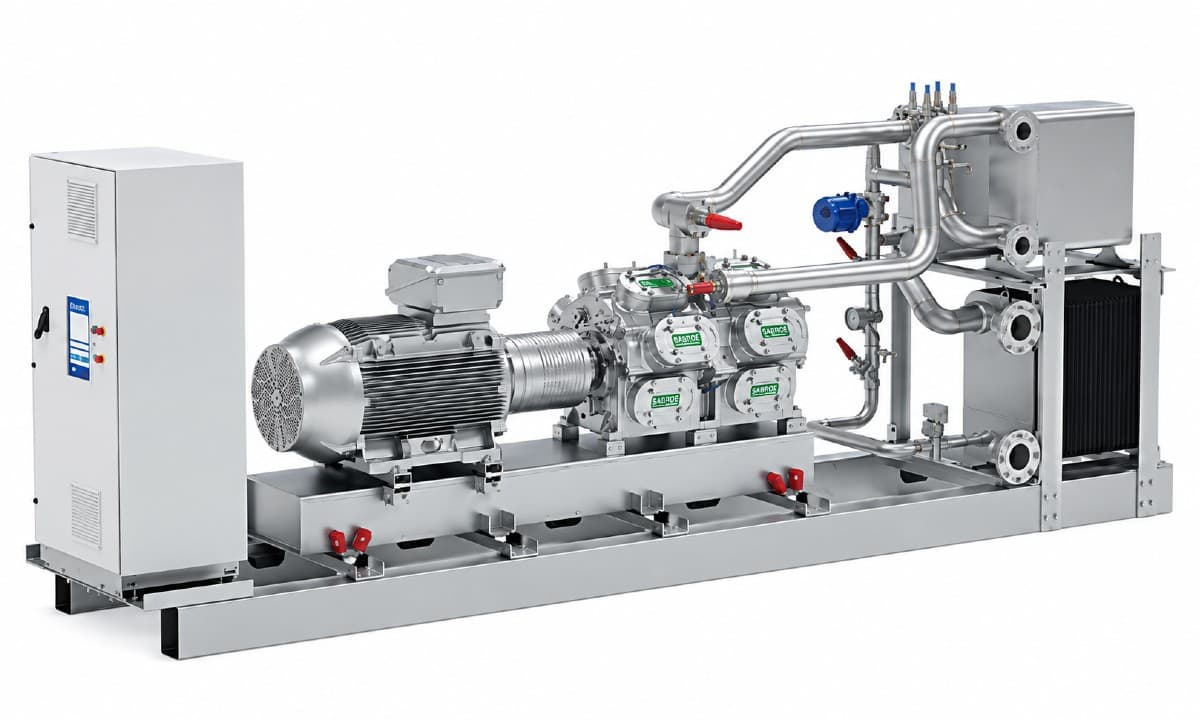
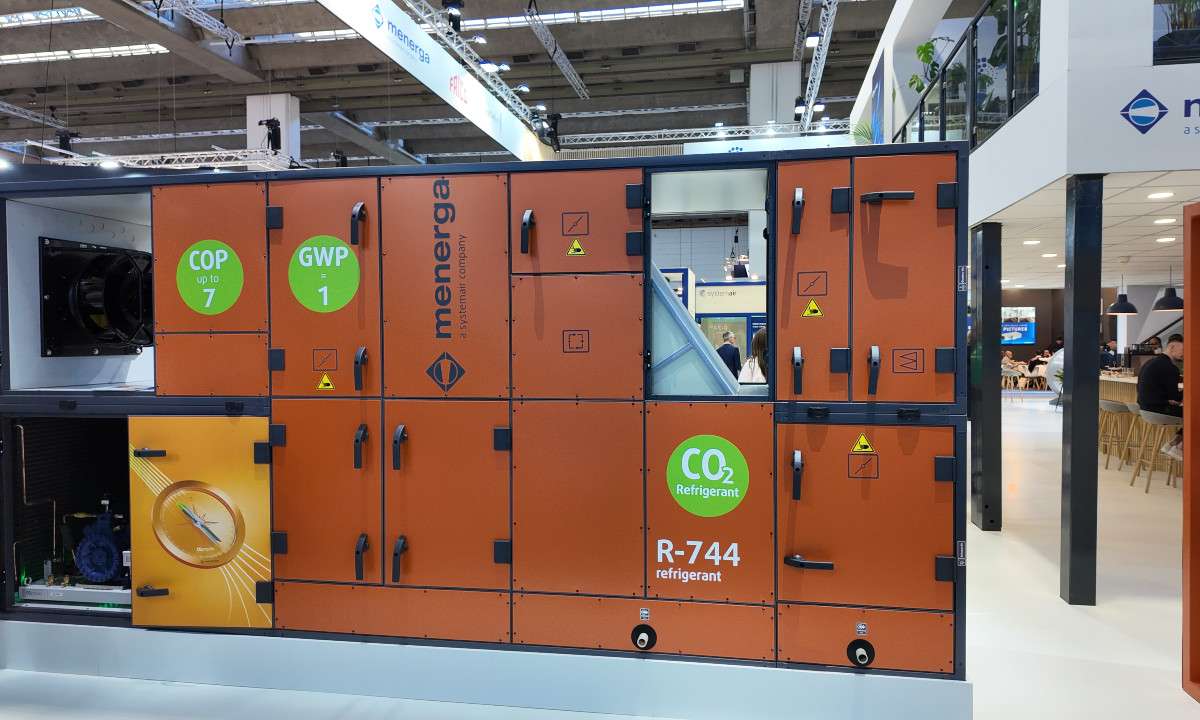
Systemair made a splash at ISH 2025 in Frankfurt with the debut of the CO2mpass, an air-handling unit (AHU) with an integrated CO2 (R744) heat pump designed to dehumidify and heat public pools. The unit was developed by Menerga, which is owned by Systemair, and was described as a prototype at the time. That label has since been ripped off, according to Anton Zupančič, CEO of Systemair Slovenia.
“We have launched the product and begun commercial sales,” Zupančič told NaturalRefrigerants.com. “In fact, we have secured our first orders, which will be produced this year, and the first deliveries are planned from early August.”
NaturalRefrigerants.com spoke with Zupančič about the CO2mpass and the company’s work with natural refrigerants more broadly in a conversation that touched on the future of the new AHU, its recently released propane (R290) commercial heat pump and its stance on PFAS (per- and polyfluoroalkyl substances).
This interview has been edited for length and clarity.
Menerga showed the CO2mpass air-handling unit at ISH 2025, referring to it as a prototype. What is the current status of the CO2mpass?
Anton Zupančič: Given the groundbreaking nature of this technology, which is significantly more advanced and complex than conventional systems, its market introduction required careful considerations. We have committed substantial resources to state-of-the-art equipment, enhanced production capabilities and a targeted marketing strategy to communicate its main benefits.
The market response has been exceptionally positive, and we received overwhelmingly strong feedback at ISH. Interestingly, it was the only solution of its kind on display. Momentum is particularly robust in the Nordic countries and Germany, where we have already secured our first commercial orders.
Interest continues to grow, not only from customers but also from investors, which further reinforces our confidence in the product’s potential. In Slovenia, we have been invited to present the technology as part of a prestigious annual innovation awards program. The overall trajectory remains highly positive, and we are confident that this technology represents a key pivot for our industry’s future.
Could the CO2mpass be used in HVAC applications outside of swimming pools, such as space heating and cooling in commercial buildings?
AZ: This represents exactly the next phase in our evolution. Our immediate priority is the pool sector, with a primary emphasis on public pools and compact residential applications. At this scale, the cost ratio of CO2 systems compared to conventional solutions remains a key consideration, particularly for smaller units.
The subsequent phase will involve expanding into reversible heat pump solutions. These systems are particularly well-suited for public buildings as well as industrial and specialized projects with exacting technical demands, such as humidity control. Our focus is increasingly on more advanced and complex applications, aligned with sustainability-driven frameworks, such as LEED and other energy-efficiency certifications. This is where we see strong long-term potential and growing market demand.
Our objective is to introduce the next generation of products to market by the second quarter of next year. This solution will be more complex than a standard reversible heat pump and will incorporate additional features, such as adiabatic cooling. Over the coming months, we will be installing and rigorously testing these systems within our factory environment in Slovenia.
What trends in European commercial HVAC is Systemair keeping an eye on?
AZ: From a market standpoint, we see significant potential in high-demand, continuous-operation sectors, such as public infrastructure, healthcare, pharmaceuticals and industrial applications. These environments require more advanced solutions, particularly where dehumidification, process control and energy recovery are critical.
A major trend we are responding to is the move toward integrated systems. Rather than treating air-handling units and heat pumps as separate components, we are engineering unified, optimized solutions. For example, integrated heat pumps with natural refrigerants, such as CO2, recover waste heat and reuse it for hot water or secondary heating, significantly improving overall system efficiency.
The true value lies in maximizing energy efficiency across the entire installation, reducing both emissions and operating costs. This also aligns closely with sustainability frameworks, like LEED and broader decarbonization targets across Europe.
Simultaneously the market environment is evolving. Some investors are more cautious, with longer project timelines and greater conservatism in decision-making. This is offset by strong growth in pharmaceuticals, advanced manufacturing and semiconductor production, where demand for high-performance energy-efficient HVAC solutions is surging.
Overall, the European market remains highly dynamic. We anticipate further regulatory and market-driven changes in the coming years, particularly around natural refrigerants and energy performance. To stay ahead, we are continuing to invest heavily in innovation, product development and technical expertise, ensuring we are well-positioned to meet the growing demand for more complex, sustainable HVAC solutions.
Systemair also recently released an R290 heat pump, the Polarix NEO. How many Polarix NEOs has Systemair sold to date and for what types of applications?
AZ: The Polarix NEO has primarily been deployed in commercial and comfort applications. We are observing clear and growing interest across multiple regions, particularly in Belgium and Germany, where initial uptake has been strongest. A similar momentum is emerging in Azerbaijan, France, Morocco, Portugal, Spain and Turkey, reflecting the broader adoption of R290-based solutions across diverse climates and applications.
While PFAS is primarily being addressed by regulators in Europe, Systemair is a global company. How is PFAS impacting its product offerings and planning outside of the EU?
AZ: While PFAS has been most proactively addressed within Europe, it is increasingly shaping our global strategy as well. We closely monitor developments across regions and aim to anticipate both legislation and market expectations. Over the past couple of years, PFAS has gained significant prominence in industry discussions. Although regulatory pressure outside the EU is not yet as advanced, awareness is growing, and we view this as an inevitable direction for the global market. For us, the removal of PFAS is the final and ultimate destination.
In practical terms, this means that sustainability considerations are by default integrated into our product development processes, supported by enhanced transparency through sustainability reporting and material assessments. While refrigerants are a key aspect of the discussion, PFAS go beyond them and impact multiple components and materials used across HVAC systems.
At the same time, progress globally is uneven. Some markets are moving faster than others, and in certain regions sustainability decisions are still more strongly influenced by short-term business considerations. Nevertheless, we believe that as leading industries and regulators, particularly in Europe, continue to set the pace, this will drive a ripple effect globally.
Meaningful change, however, will require cross-sector alignment, not just within HVAC. PFAS is used across multiple industries, and addressing it effectively will depend on broader collaboration and shared responsibility.
Why did Systemair decide to join the NaturalRefrigerants.com marketplace?
AZ: Fundamentally, our decision to join NaturalRefrigerants.com is about alignment. The platform plays a key role in advancing natural refrigerant-based technologies by fostering connections among manufacturers, stakeholders and decision-makers through credible information, market insights and product visibility. As the industry accelerates its transition toward more sustainable solutions, such platforms are increasingly vital in shaping awareness and adoption.
For Systemair, natural refrigerants are a cornerstone of our product development roadmap. By joining NaturalRefrigerants.com, we are not only showcasing our solutions but are also actively participating in a broader ecosystem that promotes low-GWP technologies, including CO2, hydrocarbons and other natural alternatives.
It also underscores our commitment to transparency and knowledge-sharing. As a global company, we see value in contributing to platforms that help educate the market, support informed decision-making and accelerate the shift toward more sustainable HVAC solutions.