As it endeavors to comply with the U.S. AIM Act and California’s state refrigerant regulations, Sam’s Club, the wholesale club division of U.S. retail giant Walmart, has been testing a transcritical CO2 (R744) refrigeration system at a refurbished club in Palmdale, California, over the past year.
An overview of the journey Sam’s Club has taken in deciding to install and test transcritical CO2 refrigeration was presented by Lance Payerli, its Senior Director, Proto Refrigeration Engineer, at the FMI (Food Industry Association) Energy and Store Development Conference in Baltimore on September 24. He was joined on stage by Chris McCarty, Director, Business Development for OEM Zero Zone, and Andre Patenaude, Director, Solutions Strategy for component manufacturer Copeland, two of the key equipment providers with which Sam’s Club collaborated on the project.
The transcritical CO2 project at the Palmdale Sam’s Club represents one of the early efforts by Walmart to deploy this refrigeration technology in the U.S. In 2023, James McClendon, Director of Energy Efficiency at Walmart, participated in a discussion of CO2 refrigerant supply in the U.S. at the ATMOsphere America conference, hosted by ATMOsphere, publisher of NaturalRefrigerants.com.
“We did this project as a test in California because it aligned with regulations and our own internal rules,” said Payerli. “[This] would allow us to learn lessons and benefit us in the future.”
One year into the CO2 system’s operation, Sam’s Club is still in the process of tracking the energy performance of the system and the usage of resources such as water, though the retailer is “confident in its ability to properly serve our club,” Payerli said.
Sam’s Club engaged in considerable discussion internally and externally during a three-year planning process before deciding to install the transcritical CO2 system. “This was a big decision, so we made sure that we reached out to others in the market to make sure that we were making the right choice for this specific club,” said Payerli. “And the recommendation that we were given was to go with a CO2 system because that was what would be best for this location.”
Payerli, McCarty and Patenaude all agreed that collaboration and communication among the parties, including Sam’s Club, equipment suppliers, refrigeration contractors, electricians, plumbers and general contractors, was critical to the success of the project. “There was a lot of discussion that needed to be had, and we needed full, open communication at all steps – not just planning the project, but all steps,” Payerli said.
“It’s also really important to educate all those involved in the differences between a CO2 system and your traditional A1 [f-gas system],” said McCarty.
“The recommendation that we were given was to go with a CO2 system because that was what would be best for this location.”
Lance Payerli, Sam’s Club
While the U.S. Environmental Protection Agency (EPA) is rolling out the provisions of the AIM Act, the California Air Resources Board (CARB) has already implemented a number of HFC regulations, such as restricting the GWP of new commercial and industrial systems to 150. Existing systems in California are facing their own GWP restrictions in the coming years, and this is what Sam’s Club is addressing in the Palmdale retrofit. “We will need to reduce the average [greenhouse gas potential] of our [existing] systems by 25% by the end of 2026 and 55% by the beginning of 2030,” said Payerli. Greenhouse gas potential is found by multiplying the charge of a system by the GWP of the refrigerant in the system.
Walmart as a whole has set a goal to reach zero emissions by 2040 across its HVAC and refrigeration systems by transitioning to “low-impact refrigerants,” said Payerli, adding, “we do not plan to use carbon offsets.”
No impact on customer
Payerli indicated that Sam’s Club converted “a large portion” of the 136,000ft2 (12,635m2) Palmdale location, which includes 30 cases and 11 walk-in rooms in total, from an HFC system to the new transcritical CO2 system. Importantly, the conversion was designed so that it would not impact the customer’s experience or close the club.
The CO2 system, which provides around 140kW (39.8TR) of cooling capacity for the store’s low-temperature applications and 190kW (54TR) for its medium-temperature applications, includes:
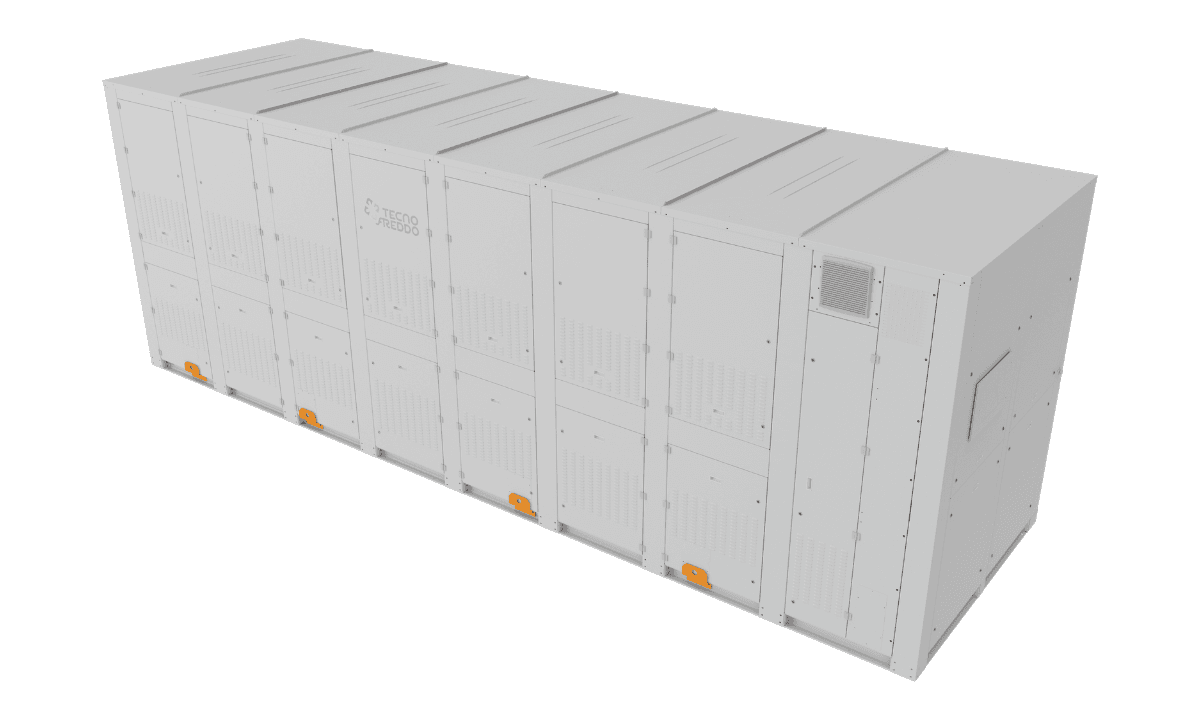
- Zero Zone’s Genesys booster rack with parallel compression
- Six Copeland 4MTLS transcritical semi-hermetic compressors (medium temperature)
- Five Copeland ZOD subcritical scroll compressors (low temperature)
- Copeland E2 controller and iPro high pressure control
- Evaporators from Heatcraft and Keeprite
- Güntner adiabatic gas cooler
- Heat reclamation for potable water
- Seismic anchors
- Leak Detection
- Multiple door options for convenient service and reduced sound level
The original HFC rack at the store was outside in the back, while the CO2 replacement rack is around the corner on the side, taking up less space and allowing shorter piping runs to the cases and walk-ins. Moreover, the new design employs loop piping rather than single-circuit piping, thereby minimizing the disruption to the club during the retrofit by quickly “jumping off the main loops and grabbing the islands, the cases and the walk-ins,” said Payerli. Loop piping also allowed the store to put more cases onto fewer lines and reduce the amount of copper used.
A key factor in the project was making sure the transcritical CO2 system could operate efficiently in the Palmdale climate, which has an average temperature of 96°F (36°C) in July, reaching as high as 115°F (46°C) last year. Copeland helped Sam’s Club design its system for this climate by sharing data from a study it conducted on high ambient mitigation strategies for transcritical CO2 systems. This persuaded Sam’s Club to adopt a system that used parallel compression along with an adiabatic gas cooler. “For adiabatic plus parallel compression, our modeling show at 18.6% annual energy savings” compared to a standard CO2 booster system in Fresno, California, which is comparable in climate to Palmdale, said Patenaude.
To ensure that the CO2 system would be reliable, Sam’s Club put the system “through its paces, so no matter what it was going to be strong and able to run within the conditions of Palmdale and serve our club,” said Payerli. In fact, the system has not suffered any refrigerant leaks to date, he noted.