Boston is exploring the use of heat pumps to decarbonize its district heating and cooling network by sourcing thermal energy from local waterways, including Boston Harbor, the Fort Point Channel and the Charles and Mystic Rivers, as well as the bedrock beneath the rivers.
Massachusetts Clean Energy Center (MassCEC) has partnered with the city to provide $500,000 (€426,000) in funding to the Boston Green Ribbon Commission (GRC) for a feasibility study. The 40-member GRC, a voluntary network of the city’s public- and private-sector leaders, is in the process of selecting an engineering firm or technical consultant with expertise in ground- or water-source heat pumps to conduct a Boston-Area Thermal Energy Network (BosTEN) evaluation. The study will assess the technical, economic and regulatory viability of using these waterways to serve the city’s district heating and cooling system.
“It’s been demonstrated and proven on campuses and for suburban areas, but we haven’t investigated this technology deeply for dense urban areas like the city of Boston,” Peter McPhee, Senior Director for Building Decarbonization at MassCEC, told the trade magazine ENR East. “And we haven’t looked into the feasibility yet of utilizing water resources like Boston Harbor as a source of energy that could heat or cool these buildings.”
The study: BosTEN’s project goals include demonstrating that thermal energy networks can reduce pollution, mitigate peaks in gas and electrical use and deliver long-term cost savings, according to the GRC.
- The GRC outlines a closed system that exchanges thermal energy through submerged or buried pipe walls, instead of drawing water from local waterways.
- Anchor institutions ‒ such as hospitals, universities, large businesses and government institutions ‒ will provide current and projected thermal energy demand data, evaluate pathways for integrating existing building systems into a district energy network and identify associated barriers and challenges.
- The feasibility study will involve utility providers National Grid and Eversource, which operate Boston’s electricity and gas infrastructure, as well as Vicinity Energy, which operates the city’s district steam network.
Current situation: Boston’s legacy district heating network relies on natural gas-fired steam boilers connected to roughly 29 miles (46km) of underground piping. The city’s climate targets include achieving carbon neutrality by 2050, with an interim goal of reducing community-wide greenhouse gas emissions by 50% by 2030, using 2005 as a baseline.
- Refrigerants are not mentioned in GRC’s request for proposals for the BosTEN feasibility study.
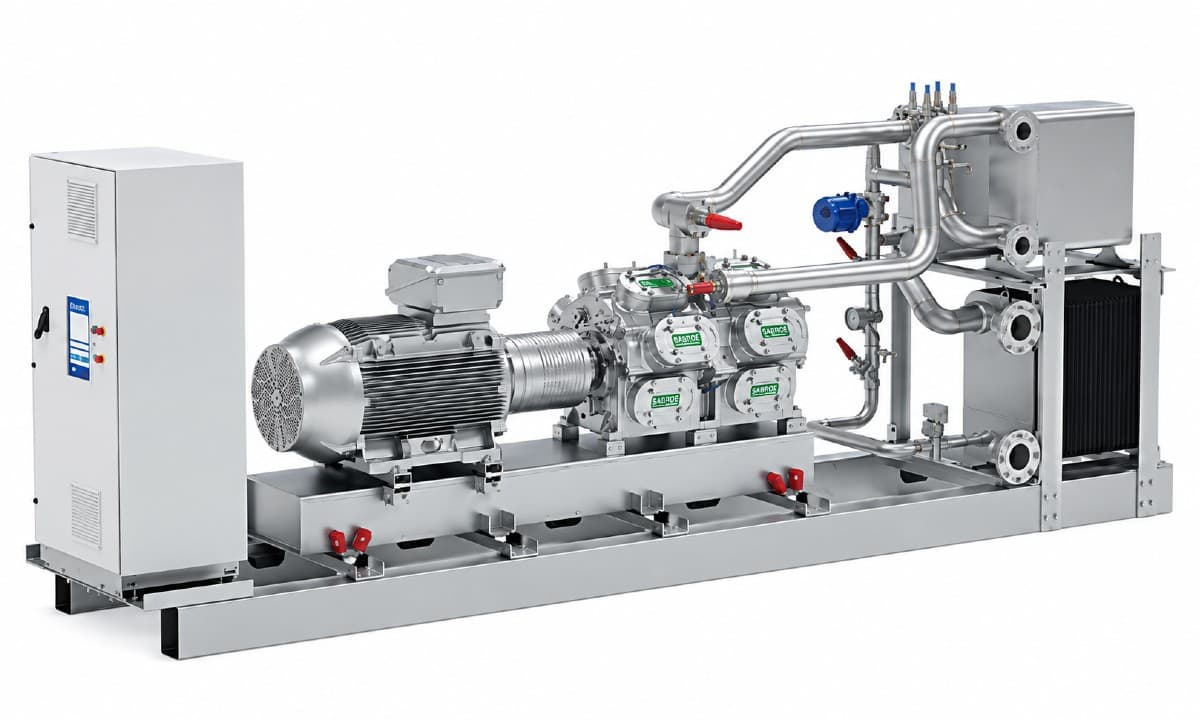
- However, in 2025 members of the group visited a district heating system in Esbjerg, Denmark, operated by DIN Forsyning. The system features a 30MW (8530TR) CO2 (R744)-based seawater heat pump manufactured by Everllence, formerly MAN Energy Solutions.
- Vicinity Energy, a Boston-based district energy provider, is installing an Everllence 35MW (9,952TR) ammonia (R717)-based steam heat pump, capable of producing roughly 50 metric tons of steam per hour using the Charles River as a heat source, in its Kendall Square facility in neighboring Cambridge.
European examples: Everllence has district network heat pump projects in various stages of implementation.
- The North Sea-sourced 30MW CO2 unit in Esbjerg provides district heating equivalent to up to 25,000 homes. The design includes a second 30MW CO2 heat pump providing a total heating capacity of 60MW (17,060TR) when the plant is fully operational. The installation replaces a coal-fired combined heat and power plant, with an estimated annual reduction of 120,000 metric tons of CO2e.
- In December 2024 Everllence announced a new district heating plant along the Rhine in Cologne, Germany, with three ammonia-based heat pumps providing a total heating capacity of 150MW (42,651TR). The units will lift the Rhine’s river water from 10 to 110°C (50 to 230°F) and heat approximately 50,000 homes, with a projected COP of 3.
Quotable: “There is an amount of electricity that’s used for both the heat pumps and for pumping [water],” McPhee said. “But when we look at the math, what it shows is that even though a portion of that electricity is coming from fossil fuels, it’s still far cleaner to do that than to combust fossil fuels [for heating].”