Swiss multinational food and beverage processor Nestlé is reconfiguring its factories and offices to meet corporate decarbonization goals using natural refrigerant heat pumps powered by renewable electrical sources, according to Vincent Grass, Global Refrigeration Leader Corporate Operations – Engineering Services.
Nestlé produces products for its more than 2,000 brands in 340 factories across 77 countries. The food manufacturer started working with natural refrigerants in 1986 and has replaced high-GWP refrigerant systems with ammonia (R717), CO2 (R744), hydrocarbons and water-based mechanical recompression, singly or combined.
“Our reduce, rethink and replace strategy with thermal circularity has cut energy consumption on average by 50% in our reconfigured food factories,” said Grass in a presentation at the ATMO Europe Summit 2024.
The event, organized by ATMOsphere, was held November 25‒26 in Prague, Czech Republic. ATMOsphere is the publisher of NaturalRefrigerants.com.
Reconfiguration strategies: Nestlé’s corporate goals for decarbonization include using 100% renewable energy by 2025, cutting its carbon footprint in half by 2030 and achieving net zero by 2050.
- Reducing differential temperatures from generation to process requirements cuts energy consumption. As an example, Grass referred to a U.S. factory raising its output freezing temperature from −42 to −35°C (−43.6 to −31°F) and lowering its steam generation from 165 to 110°C (329 to 230°F).
- “We configure factories to recycle and reuse the energy as many times as possible,” Grass noted, adding that for small loads requiring higher temperatures, the company uses direct electricity and biofuels as a last resort for higher capacity requirements.
Heat pumps: “For heat generation, heat pumps offer the most efficient technology,” Grass remarked.
- The natural refrigerant system chosen by the company for a factory or office HVAC reconfiguration depends on the situation. “CO2 works well for drying processes with outlet air temperatures up to 120°C (248°F), hydrocarbons for low temperature changes and ammonia for larger water-cooled plants,” Grass said.
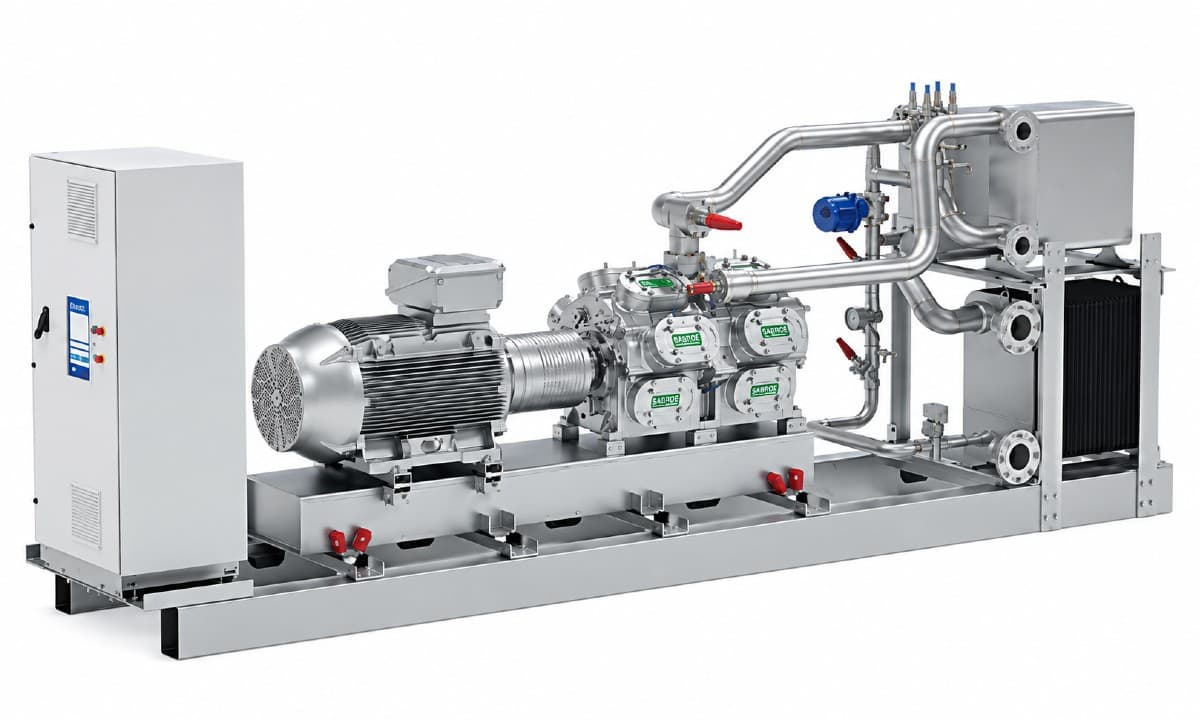
- A GEA ammonia heat pump installed last year in a new production line at Nestlé’s expanding infant formula plant in Nunspeet, the Netherlands, helped cut energy consumption from steam generation by 75%.
- In spring 2025, Nestlé will install a fourth ammonia heat pump in its international headquarters in Vevey, Switzerland. According to Grass, the completed system will provide net zero thermal climate control for the office building using cooling from the adjacent lake and waste heat from a data center.
Pushing the boundaries: Working in partnership with Scottish OEM Star Refrigeration, Nestlé pushed the operational capacity of ammonia heat pumps to achieve hot water temperatures of 90°C (194°F) in 2012 in its Halifax, Nova Scotia, plant using Copeland/Vilter single screw compressors.
- Grass announced that Nestlé seeks to push the boundaries again in collaboration with Vitler to condense ammonia at 120°C using single screw technology. “This advancement would enable us to utilize a single refrigerant to generate steam above atmospheric pressure, streamlining our processes and enhancing efficiency,” Grass explained.
- Nestlé won the Best-in-Sector/Industrial End User award at the ATMO Europe Summit 2024.
Quotable: “The choice between natural refrigerants and HFOs comes down to managing safety or forever pollutants,” Grass said. “We decided to manage safety and go for natural refrigerants.”
“For heat generation, heat pumps offer the most efficient technology.”
Vincent Grass, Global Refrigeration Leader at Nestlé