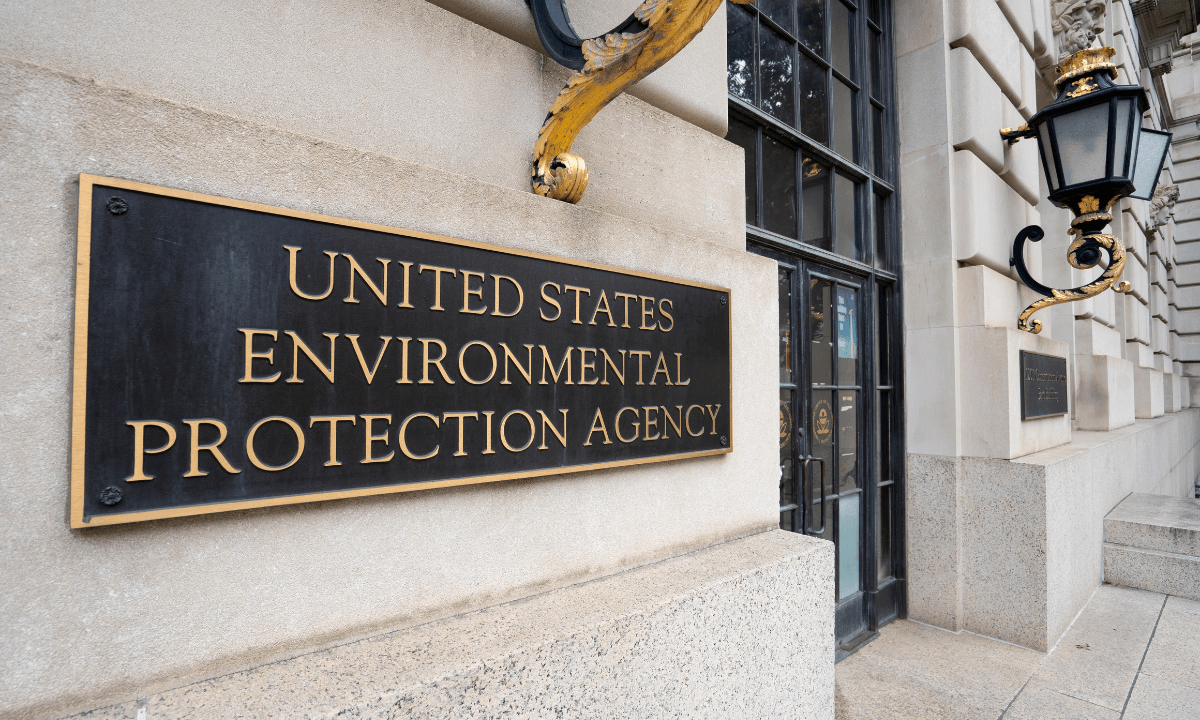
A U.S. federal appeals court on August 1 denied challenges by two domestic refrigerant manufacturers – Choice Refrigerants and IGas – to the implementation of HFC reduction measures prescribed by the American Innovation and Manufacturing (AIM) Act of 2020.
A three-judge panel of the U.S. Court of Appeals for the District of Columbia Circuit rejected the companies’ arguments that the U.S. Environmental Protection Agency (EPA) could not constitutionally implement a 2023 rule calling for a 40% reduction in HFC production and import below historical levels from 2024 through 2028 through the allocation of cap-and-trade allowances to industry stakeholders.
The rule aligns with the AIM Act’s goals to reduce the production and imports of these climate-damaging HFC refrigerants by 85% by 2036 and help avoid up to 0.5°C (0.9°F) of global warming by 2100. The AIM Act established a gradual phase down, starting with a 10% reduction in through 2023, followed by the 40% reduction through 2028 and cuts of 70% (2029 to 2033), 80% (2034 to 2035) and 85%.
Choice Refrigerants argued that Congress violated the “nondelegation doctrine” when it granted the EPA authority to allocate use allowance and that the EPA unconstitutionally exercised legislative power when it promulgated the 2024 rule. IGas contended that the EPA’s exclusion of 2020 data due to the Covid pandemic from its market-share calculations was arbitrary and capricious.
Two trade associations — the Air-Conditioning, Heating and Refrigeration Institute (AHRI), and the Alliance for Responsible Atmospheric Policy — intervened as respondents.
Court refers to CFC/HCFC phase out
The appeals court noted that the EPA rule reducing HFC production and consumption was not unprecedented. “Congress has employed cap-and-trade programs to phase out industrial use of other hazardous refrigerants, including chlorofluorocarbons (CFCs) and hydrochlorofluorocarbons (HCFCs). Those predecessor programs are the model for the one at issue in this case.”
Zhonette Brown, a lawyer for Choice Refrigerants, told Reuters her client was evaluating next steps, and the EPA said it is reviewing the ruling. “The agency in February sought unsuccessfully to have the case put on hold, citing the need for new agency leadership under Republican President Donald Trump to review the regulation,” said Reuters.
Also in 2023 the EPA released a final Technology Transitions rule under the AIM Act to restrict the use of HFCs where alternatives such as natural refrigerants are already available. In March, the EPA announced that it would be pursue a “reconsideration” of the Technology Transition rule.
In September of 2024 the EPA announced a third final rule under the AIM Act designed to enhance the management, recycling and reuse of HFCs. In January, U.S. House Representative Neal Dunn, a Florida Republican, introduced a joint resolution to strike down the management rule. It was followed by a comparable Senate resolution from Kansas Senator Roger Marshall, also a Republican.
“Congress has employed cap-and-trade programs to phase out industrial use of other hazardous refrigerants, including chlorofluorocarbons (CFCs) and hydrochlorofluorocarbons (HCFCs). Those predecessor programs are the model for the one at issue in this case.”
A three-judge panel of the U.S. Court of Appeals for the District of Columbia Circuit