For Michael Freiherr it’s not a matter of “if” the world will transition to natural refrigerants but rather “when” and how quickly. As the Head of Technologies and Innovation – as well as a Managing Director – at Güntner Group Europe, Freiherr is well-positioned to make such a bold statement. Güntner has worked with natural refrigerants since its founding in 1931 and today has offices in more than 50 countries and six factories across Europe, Asia and the Americas.
While Freiherr sees a global transition to natural refrigerants as inevitable, Güntner’s vision for the future of the HVAC&R industry extends beyond refrigerants. The company is eyeing further advancements in digitalization and the increased implementation of artificial intelligence to make complicated heating and cooling systems easier to manage and maintain.
Freiherr recently spoke with NaturalRefrigerants.com about the global refrigerant transition, including developments in the data center sector and the Chinese market, as well as Güntner’s product development roadmap.
This interview has been edited for length and clarity.
How is Güntner helping drive the transition to natural refrigerants?
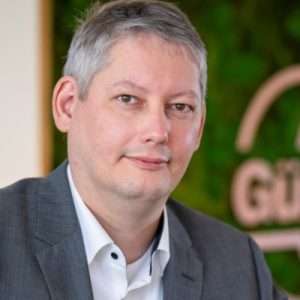
Michael Freiherr: When Güntner was founded in 1931 natural refrigerants were simply the standard. That heritage has remained a consistent thread throughout our journey. We became a founding member of eurammon 30 years ago and supplied our first CO2 [R744] products in the 1990s and have continuously invested in dedicated testing facilities for CO2 and ammonia [R717].
Today the industry faces a different challenge. The technical case has largely been made, and what matters now is making natural refrigerants easy to adopt on a global scale.
We made a clear commitment several years ago: Wherever natural refrigerants provide the best solution for the application, every standard Güntner product should also be available for their use. We achieved that milestone this year. For us, supporting the transition is not about offering a few flagship products. It is about removing barriers for customers and making natural refrigerants an obvious choice whenever they are the right technical solution.
Güntner recently formed a data center cooling division in Germany. What will it take for natural refrigerants to play a bigger role in data center cooling?
MF: Artificial intelligence and increasing computing densities are leading to higher heat loads. In many projects today our equipment is used to cool water-cooled chillers where the key challenges are minimizing energy consumption, reducing noise emissions and lowering water consumption.
Rather than speculating on which refrigerants will dominate the market, I believe the more important question is what data center operators need. They need confidence that their cooling infrastructure will remain efficient, reliable and compliant throughout its lifecycle – not only technically but also from a regulatory perspective. This is where decades of experience with natural refrigerants become particularly valuable.
Looking ahead, the industry should expand the discussion beyond cooling. As AI drives ever greater heat generation, the next question will be how to turn this waste heat into a valuable energy resource. That requires close collaboration between technology providers, data center developers, utilities and city planners. We see ourselves as an active partner in enabling those conversations.
“Today the industry faces a different challenge. The technical case has largely been made, and what matters now is making natural refrigerants easy to adopt on a global scale.”
Michael Freiherr,
Head of Technologies and Innovation, Managing Director
Güntner Group Europe
We recently wrote about two large-scale heating and cooling projects in China using CO2 systems, both of which Güntner worked on. Can you tell us more about the development of the Chinese market for CO2?
MF: What we’ve observed globally is that the adoption of natural refrigerants accelerates wherever regulation, energy efficiency and industrial capability come together. China has repeatedly demonstrated how quickly it can scale new technologies once these conditions are in place.
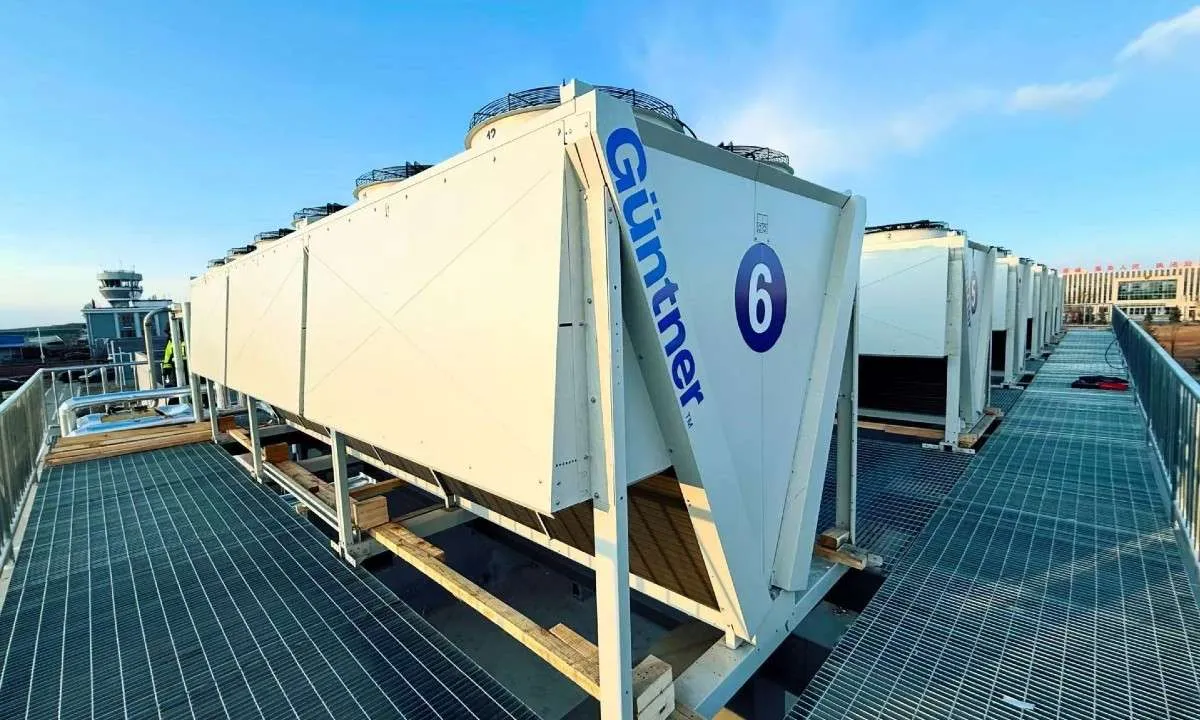
There is growing interest in large-scale CO2 applications for heating and cooling, particularly in projects where decarbonization, energy efficiency and heat recovery are key design objectives. Projects such as the Ordos zero-carbon airport and the AstraZeneca pharmaceutical campus in Qingdao illustrate how CO2 technology is moving beyond refrigeration into integrated heating, cooling and heat recovery solutions that support ambitious carbon reduction goals.
For a global company like Güntner, this reinforces the importance of providing proven technologies that can be deployed consistently across different markets while meeting local requirements. Ultimately, our focus is less on predicting which country will move fastest and more on ensuring that our customers are ready whenever market conditions create new opportunities.
Where else in the world is Güntner seeing a rise in the uptake of natural refrigerant-based heating and cooling systems?
MF: What I find most interesting is that every major technology transition tends to start somewhere before gradually spreading across the world. CO2 is a good example.
Europe has played a pioneering role in the adoption of CO2 technologies, which has become the standard for supermarket refrigeration and is increasingly expanding into other applications, such as industrial refrigeration. In Japan we saw early momentum for CO2, while in the United States we are now seeing growing interest in industrial heat pumps and other high-efficiency heating and cooling solutions.
One of the most memorable conversations I had was with a representative from a small island nation during COP28. He explained that they simply cannot afford inefficient cooling technologies because energy itself is a scarce resource. For them, investing in the most efficient technology is not an environmental statement: It is an economic necessity. I have often thought about that perspective.
That is why I believe the global transition to natural refrigerants is no longer a question of if but of when and at what pace. Ultimately, customers everywhere are looking for the same outcome: solutions that combine sustainability with measurable operational and economic benefits.
What trends in natural refrigerants is Güntner watching and how are these impacting its product development roadmap?
MF: The conversation has evolved. Natural refrigerants are no longer the defining innovation topic but rather the foundation upon which future-proof cooling technologies are built. The industry has demonstrated that natural refrigerants work. At Güntner, we have established one of the broadest and deepest standard product portfolios for natural refrigerant applications, and we will continue to refine and optimize it.
Today, however, our development priorities increasingly focus on the performance of the entire system rather than the refrigerant itself because this is ultimately where our customers create value. We see the greatest opportunities in improving energy efficiency, reducing refrigerant charge, minimizing water consumption and noise emissions, developing more efficient defrost technologies and leveraging digitalization and industrial AI to optimize plant operation throughout its entire lifecycle.
One of the biggest opportunities lies in enabling customers to operate increasingly complex cooling systems without specialized expertise onsite. Predictive maintenance, intelligent controls and data-driven optimization will play an increasingly important role in improving efficiency, resilience and ease of operation.
Natural refrigerants remain the essential foundation for sustainable cooling. The next wave of innovation, however, will come from making entire cooling systems smarter, more efficient and easier to operate. Ultimately, innovation is no longer about optimizing individual components but about creating value across the entire lifecycle of the cooling system.
Why did Güntner decide to join the NaturalRefrigerants.com marketplace?
MF: The transition to natural refrigerants is a shared industry effort. Progress depends on exchanging knowledge, sharing practical experience and building confidence in technologies that have already proven their value.
That is why joining the NaturalRefrigerants.com marketplace was a natural step for us. It brings together companies, experts and end users who are shaping the future of sustainable cooling and heating. It provides an excellent opportunity to share our experience, showcase proven natural refrigerant solutions and engage with a highly relevant global community.
For Güntner, innovation has never been about developing products in isolation. It is about working together with customers, partners and the wider industry to solve complex challenges. Ultimately, technology only creates value when it is applied. The faster knowledge spreads, the faster innovation becomes reality.