U.S.-based cold storage and sample management manufacturer Hamilton Storage, a division of the Hamilton company, has transitioned its entire automated ultra-low-temperature (ULT) portfolio for biological samples to natural refrigerants.
The company started developing an automated natural refrigerant storage portfolio more than eight years ago, Hamilton Storage told NaturalRefrigerants.com. It launched the Verso Q-Series with propane (R290) in 2020. The new natural refrigerant BiOS refrigeration system uses a combination of CO2 (R744), propane and ethane (R170).
“A standard full line of storage systems available with 100% green refrigerants offers measurable positive environmental benefits,” Hamilton Storage said. “[It] enables our customers to reduce their impact on the environment and deliver on their sustainability goals.”
Hamilton Storage’s automated BiOS systems are most commonly used for large-scale biobanking operations, storing biological materials at −80°C (−112°F). It supports longitudinal studies, including human disease research and personalized medicine initiatives, clinical trials, diagnostics, forensics, agriculture production and environmental and biodiversity studies.
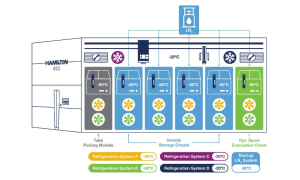
The design: The refrigeration architecture of the BiOS system includes two temperature zones, with samples compartmentalized in individual chest freezers.
- Redundant refrigeration systems protect sample integrity; each chest freezer is equipped with a dedicated connection to a liquid nitrogen-based auxiliary cooling system.
- The chest freezers sit inside an insulated −20°C (−4°F) cold room cooled by a single-stage R744 system. Depending on the size of the cold room, it contains two or four 4.2kW (1.2TR) cooling capacity systems.
- A modular cascade system using R290 and R170 cools the chest freezers, with each refrigeration module providing roughly 450W (0.13TR) of cooling capacity. The available set storage temperature ranges from −70 to −80°C (−94 to −112°F).
The benefits: “[Our] BiOS systems combine automation with green refrigeration to enable biorepositories to use up to 75% less power compared with traditional manual freezer environments,” Hamilton Storage said. The energy savings depend on the model size and the number of manual freezers replaced, with larger systems generally producing greater impact.
- Hamilton Storage’s natural refrigerant Verso Q-series, with storage temperatures ranging from ambient down to −20°C, delivers up to 20% energy savings compared to traditional refrigerants, according to the manufacturer.
- The company estimates that worldwide BiOS installations have replaced 3,000 manual ULT freezers.
More options: A few other manufacturers offer hydrocarbon-based ULT equipment for biological storage.
- In 2024 German temperature control equipment manufacturer Lauda launched Mobifreeze M 270, a mobile ULT chest freezer using R290 and R170 refrigerants. The battery-powered unit, rechargeable via wall outlet, offers a setpoint cooling range from −86 to −50°C (−123 to −58°F) for the transport of temperature-sensitive samples.
- PHC Corporation of North America, a subsidiary of Japanese PHC Holdings Corporation, manufactures PHCbi VIP ECO, a manual ULT chest freezer using R290 and R170 refrigerants, with a compressor cooling capacity of 750W (0.21TR) and a temperature control range from −86 to −40°C (−40°F). It uses 30% less energy than other leading ENERGY STAR-Certified freezers in its class, according to the manufacturer.
Quotable: “Compliance matters, and labs choosing Hamilton will not have issues meeting current and impending regulations nor sourcing synthetic refrigerants,” Hamilton Storage said. “Besides respecting the future of our planet, the energy efficiency [of the green refrigerants] means reduced energy use and costs.”
“[Our] BiOS systems combine automation with green refrigeration to enable biorepositories to use up to 75% less power compared with traditional manual freezer environments.”
Hamilton Storage