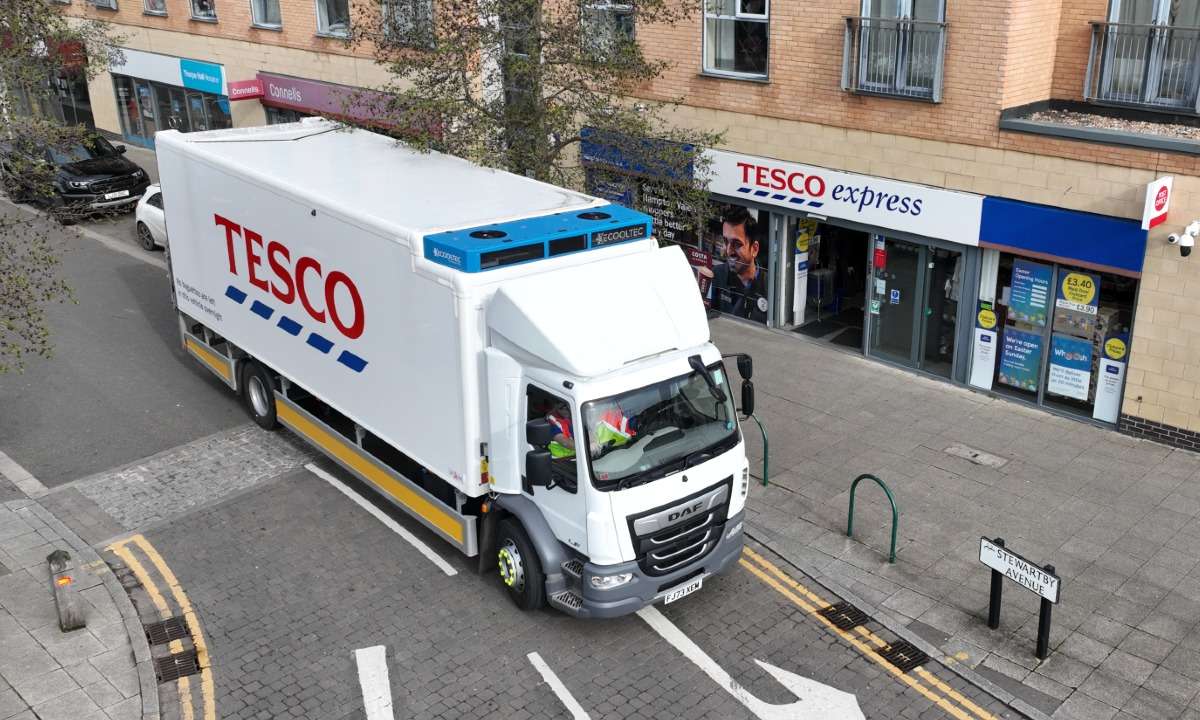
Tesco, the U.K.’s largest supermarket chain, has taken delivery of two refrigerated trucks that use propylene (R1270)/CO2 (R744) refrigeration units from German manufacturer ECOOLTEC, becoming the first company in the country to adopt the technology.
According to a statement from ECOOLTEC, its electric TM182 unit is “unique” in the heavy-duty commercial transportation sector and offers zero-emission refrigeration when operated in battery mode.
“While the phase out of f-gases within the EU is a given fact, we also notice outside the EU that industries are increasingly looking for ways to reduce their carbon footprint,” ECOOLTEC CEO Henning Altebäumer told NaturalRefrigerants.com. “We offer a solution for the missing link of the F-gas-free cold chain: Our ECOOLTEC TM182 is perfect to meet these sustainability goals.”
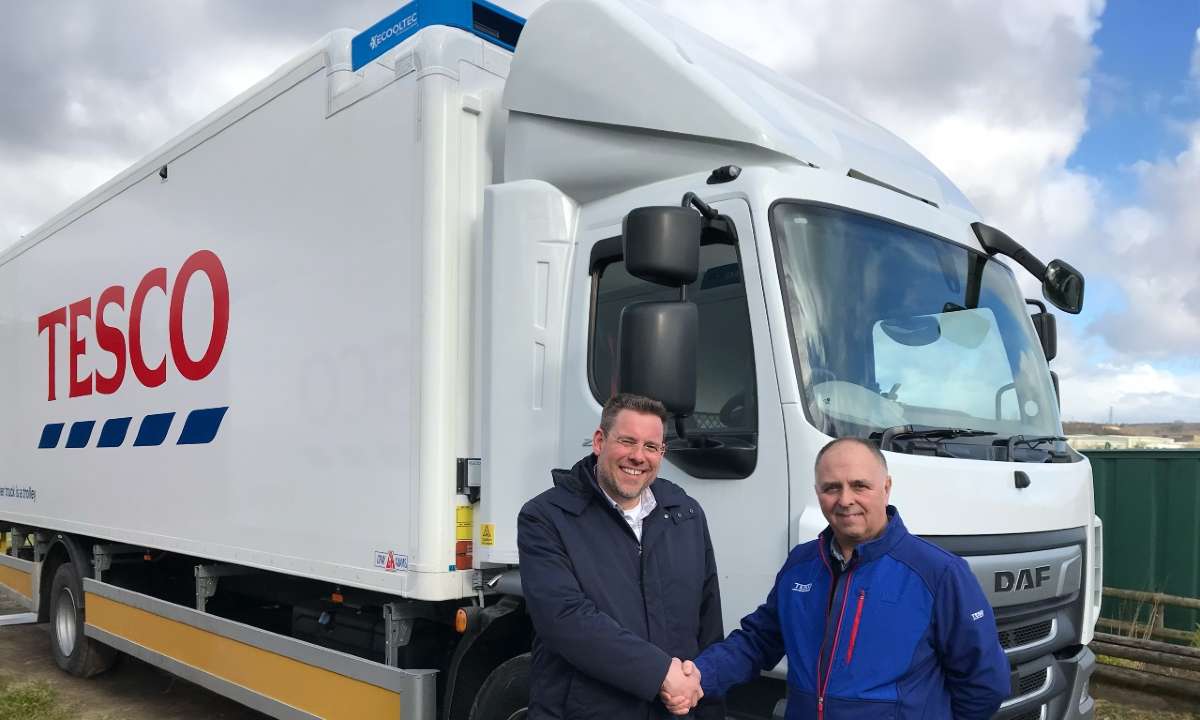
“As we look to decarbonize our transport, using lower-impact refrigeration will play an important role in our efforts to become net zero by 2035,” said Cliff Smith, Fleet Engineering Manager at Tesco.
“We offer a solution for the missing link of the F-gas-free cold chain.”
Henning Altebäumer, CEO of ECOOLTEC
The bodywork of the two new 18-ton trucks was designed by ECOOLTEC in partnership with Gray & Adams, a British manufacturer of specialist temperature-controlled vehicles. The multi-temperature box body can be divided into two compartments with a moveable transverse bulkhead system. This allows for the simultaneous transportation of chilled and frozen products between Tesco’s cold storage warehouse in Peterborough and its surrounding stores.
“Gray & Adams is delighted to be able to once again support Tesco in their mission to reduce the carbon footprint across their distribution fleet,” said Ryan Mazgaj, Sales Manager at Gray & Adams.
Installed on the roof, ECOOLTEC’s TM182 unit houses the low-charge propylene circuit, which is hermetically sealed to maximize operational safety. This connects to the secondary CO₂ refrigeration circuit that serves the system’s evaporators via a brazed plate heat exchanger.
Cold air from the TM182 unit is distributed by a single ECOOLTEC E1221 evaporator in the truck’s front compartment and a double ECOOLTEC E1312 evaporator in the second compartment.
Reduced direct emissions
ECOOLTEC’s TM182 transportation refrigeration unit is fully electric and can be powered via the manufacturer’s G30 alternator, which is mounted to the truck engine, or charged via a wall outlet.
In battery mode, the unit does not produce any direct emissions, and when powered by the alternator, it produces 98% fewer emissions than a diesel-powered refrigeration system, according to the manufacturer. These emissions savings are due, in part, to the unit’s efficiency, which requires 60–80% less energy than conventional diesel powered systems of the same capacity.
With negligible GWPs compared to the HFCs commonly used in transport refrigeration, the TM182’s refrigerants – CO2 and propylene – also have a minimal climate impact in the event of a leak. Per ECOOLTEC, the refrigerant leakage rate for transport refrigeration systems can be as high as 30% due to many not having fully hermetic refrigerant circuits.
As HFCs can have a GWP hundreds or thousands of times higher than CO2, a leak can result in the emission of multiple tons of CO2 equivalent per year per unit.
“The total refrigerant charge in typical systems for heavy-duty commercial vehicles is up to 14kg [30.9lbs], depending on the exact specification,” explained ECOOLTEC. “In this case, an average of around 4.2kg [9.3lbs] of f-gases per vehicle is released into the atmosphere every year. Depending on the refrigerant, this corresponds to a CO2 equivalent of around 9 tons per year and per unit.”
In contrast, if 1kg (2.2lbs) of propylene leaks, less than 1kg of CO2 equivalent is released into the atmosphere.
“Furthermore, HFC-based refrigerants belong to so-called perpetual chemicals,” the manufacturer added. “When they are released into the atmosphere, they are also responsible for the formation of environmentally harmful substances such as [per- and polyfluorinated Substances](PFAS).”
ECOOLTEC first launched its TM182 unit in August 2022 and began rolling out the product in April 2023. The TM182 was named Innovation of the Year/Refrigeration at the European ATMO Awards 2023.
An ongoing transition
As noted in its “Climate Change and Energy Factsheet,” Tesco is gradually transitioning to natural refrigerant-based systems as its existing equipment reaches its end-of-life, with a plan to phase out all HFCs by 2035. During the 2022/23 financial year, Tesco invested £60 million (€70.1 million/$74.6 million) into decarbonizing its refrigeration systems – with a focus on CO₂-based technologies – as well as electrifying its online delivery fleet.
Beyond its refrigerated transport, Tesco has installed transcritical CO₂ systems at around 1,000 of its stores – roughly one-third of its locations – as of October 2022. Beginning in the early 2000s, the company worked with Scottish OEM Star Refrigeration to transition its four R22-based distribution centers to ammonia (R717).