As part of California’s F-gas Reduction Incentive Program (FRIP), the North American Sustainable Refrigeration Council (NASRC) has launched a Workforce Development Initiative to support the design, installation and maintenance of ultra-low-GWP refrigeration systems.
As a nonprofit organization, NASRC supports facilitating the region’s transition to natural refrigerants, including ammonia (R717), CO2 (R744) and hydrocarbons. The new initiative aims to strengthen existing HVAC&R trade programs, facilitate equipment partnerships, recruit new technicians, provide in-person and online training and curate an online troubleshooting platform.
“A successful transition to ultra–low–GWP refrigerants is fully dependent on the success of the technician workforce,” said Danielle Wright, Executive Director of NASRC. “The FRIP Workforce Development Initiative is designed to tackle the workforce shortage from every angle, connecting education, industry and government to create sustainable, long–term solutions.”
In March NASRC allotted $3 million (€2.8 million) of its $6.5 million (€6 million) third-party FRIP administration budget funded by the California Air Resources Board (CARB) to support refrigeration workforce development. These funds are part of the CARB’s $65 million (€60 million) FRIP, which promotes the adoption of commercial and industrial refrigeration technologies with a GWP of less than 10.
Tried and true: The initiative builds on programs already successfully implemented by NASRC, including recruiting seminars, free training events as part of its R-TRADE program and train–the–trainer workshops.
- The nonprofit will host two refrigeration career recruiting events ‒ one in December 2025 and one in April 2026 ‒ with the intent of reaching at least 200 students.
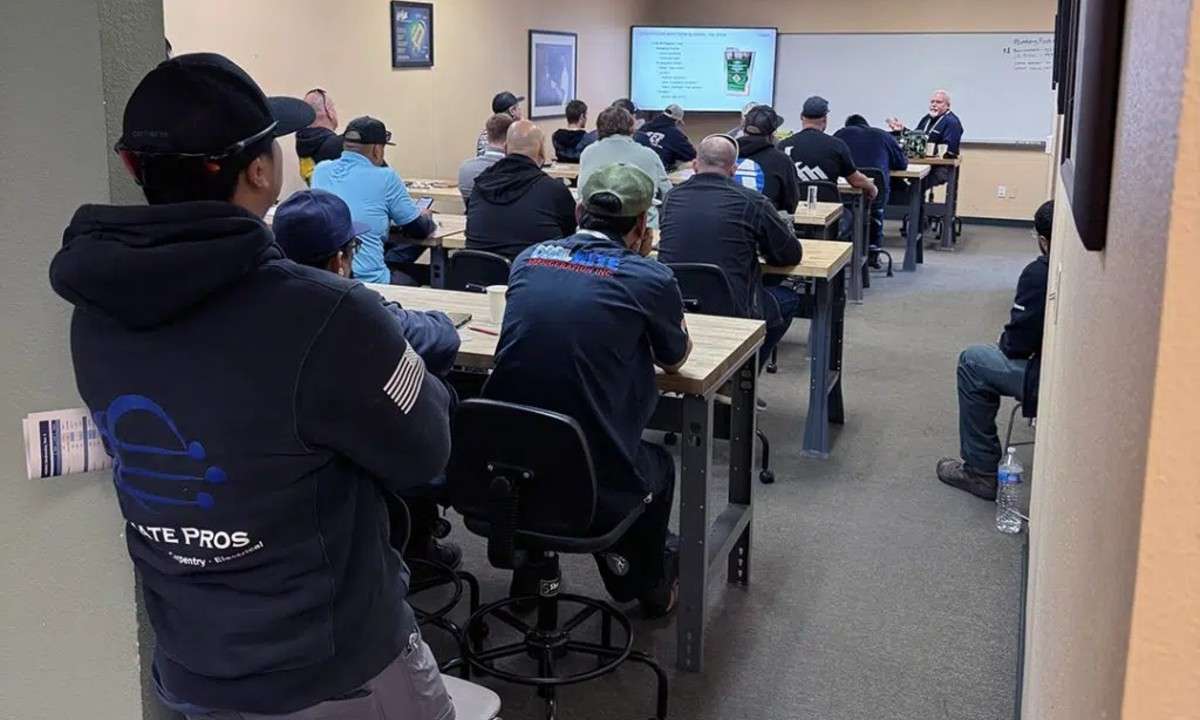
- NASRC seeks to facilitate access to foundational natural refrigerant proficiency by conducting two free training events by April 2026, with the aim of involving at least 300 Californian technicians.
- It will also host two separate faculty training events ‒ one in Central California and another in Northern California ‒ with the goal of integrating ultra-low-GWP refrigerant curriculum into three or four HVAC&R trade school programs by summer 2026.
Increasing competency: NASRC is engaged in a few other measures to promote in–depth technician understanding of natural refrigerant systems.
- The nonprofit intends to establish two training sites in the state by fall 2026, with industry partners providing CO2 and R290 equipment for hands-on learning.
- NASRC offered an advanced refrigeration workshop on December 4, 2025, in Stockton. It covered transcritical CO2 booster system start-up and troubleshooting.
Online resources: In addition to its in-person events, NASRC offers digital education for natural refrigerant solutions.
- “[Our] online CO2 training course provides 8 hours of flexible vendor-neutral instruction,” NASRC said. Through the portal, set to launch in January 2026, the nonprofit aims to train at least 100 technicians in 2026.
- The group is curating a centralized troubleshooting platform with videos and resources co-developed with industry partners to enhance technician skills and reduce refrigeration downtime.
Quotable: “CARB recognizes that an investment in upskilling the workforce is critical to the successful transition towards ultra-low-GWP technologies,” said Michael FitzGibbon, Chief of CARB’s Atmospheric Sciences and Climate Strategies Branch. “Contractors and technicians that service and install refrigeration systems throughout the state are integral to a zero-carbon future in California.”