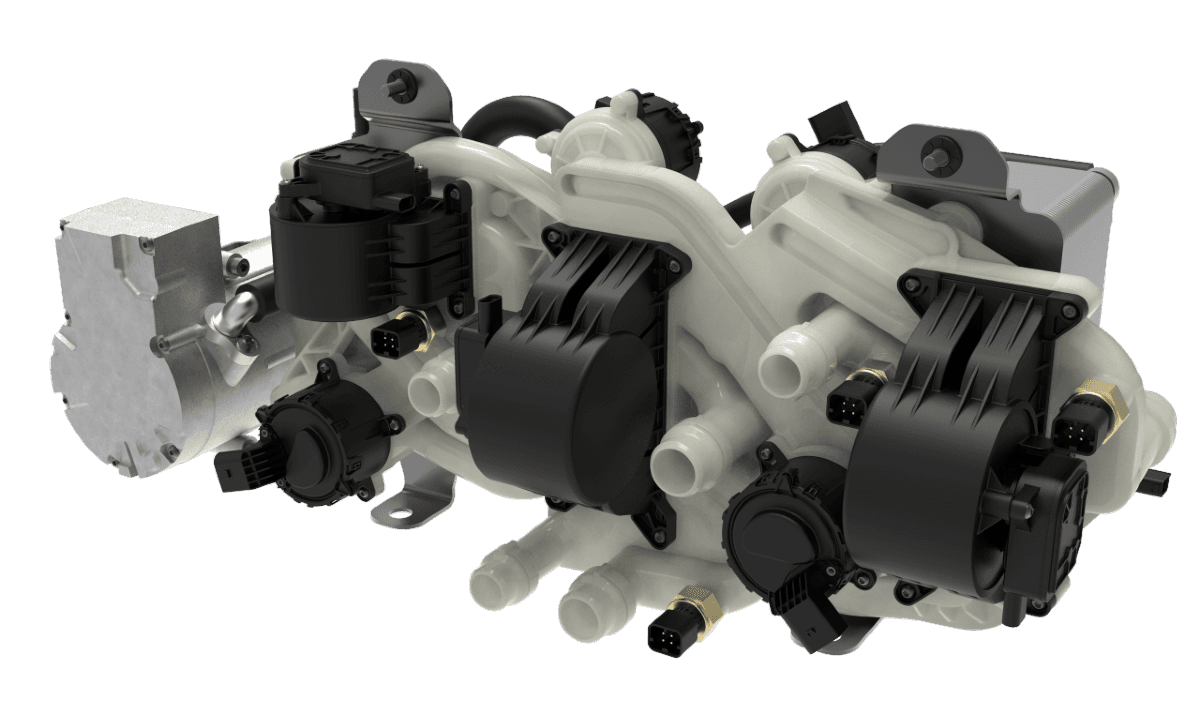
MT Innovation, an Italian company specializing in product research and development, has created a prototype mobile air-conditioning (MAC) unit for camper vans that uses ammonia-water (R717-R718) absorption technology.
The unit offers a cooling and heating capacity of 3kW (0.85TR) and 6kW (1.7TR), respectively, and MT Innovation said it uses only 5% of the electricity required by traditional camper van MAC systems. It can provide space heating and cooling and domestic hot water. MT Innovation did not specify the charge size of its prototype MAC unit.
“A car typically consumes around 2L [0.52gal] of fuel every hour to cool the passenger compartment,” Luca Barin, Research and Development Specialist at MT Innovation, told NaturalRefrigerants.com. “Our system, however, uses between 0.1 to 0.6L [0.02 to 0.15gal] of fuel per hour. It uses 0L when the cooling heat is fully recovered from the engine and up to 0.6L when the vehicle is off or parked.”
Designed to be scalable and adaptable, the system is built in blocks with the fluid supply circuit separated from the refrigeration section. The company notes its modular design ensures compatibility with a variety of vehicles outside of camper vans and even boats. The prototype measures 60 × 40 × 35cm (23.6 × 15.7 × 13.8in) – those dimensions are expected to shrink by 30% in the production version according to Barin – and weighs less than 30kg (66lbs).
The ammonia-water absorption cycle requires heat, which can be provided by waste heat in gas-powered vehicles or by a small burner that can use gasoline from the vehicle’s tank, hydrogen from a fuel cell or natural gas as its fuel source. MT Innovation has not disclosed the charge size of the unit.
MT Innovation said it patented its ammonia-water absorption MAC unit in 2020 and that it received financing for the project from the Italian Ministry of Economic Development (MISE) at the end of 2021. The company told NaturalRefrigerants.com that a working prototype will be presented to “interested companies” in September 2024.
The technology
MT Innovation’s prototype MAC system operates by leveraging the absorption properties of ammonia and water. Ammonia acts as the refrigerant, while water serves as the absorbent. The cycle begins in the evaporator, where ammonia absorbs heat and evaporates. The gaseous ammonia is absorbed by water in the absorber, creating an ammonia-water solution. This solution is then pumped to the generator where heat is applied, causing the ammonia to vaporize and separate from the water.
The ammonia vapor proceeds to the condenser, where it releases heat and condenses back into a liquid. Before returning to the evaporator, the ammonia passes through an expansion valve, lowering its pressure and temperature and allowing it to absorb heat once more in the evaporator.
Throughout the process, the regenerative heat exchanger helps to improve efficiency by transferring heat between the solutions entering and leaving the generator. The dephlegmator is involved in removing any remaining water vapor from the ammonia vapor, ensuring pure ammonia enters the condenser.

NatRefs in MAC
While ammonia-water absorption technology has not been seen before in the MAC sector, the use of natural refrigerants is on the rise.
According to a recent white paper from consulting firm Ducker Carlisle, manufacturers of plug-in-hybrid electric vehicles and electric vehicles are “high likely” to opt for natural refrigerants like CO2 (R744) or propane (R290) in place of HFO 1234yf in mobile air-conditioning systems over the next five years. The consulting firm notes that this shift is driven by stricter environmental legislation and an anticipated EU regulation that could ban R1234yf by 2030.
The transition is also influenced by government subsidies favoring low-GWP refrigerants and the need to improve vehicle performance, particularly battery range and lifespan. CO2 heat pumps, for example, have shown higher efficiency in EVs due to increased suction vapor density and the elimination of auxiliary heaters.
This trend is further evidenced by Volkswagen’s commitment to using R744 heat pumps in all its EVs by 2030, a strategy the Ducker Carlisle white paper said is likely to be followed by other automakers.
“A car typically consumes around 2L [0.52gal] of fuel every hour to cool the passenger compartment. Our system, however, uses between 0.1 to 0.6L [0.02 to 0.15gal] of fuel per hour. .”
Luca Barin, Research and Development Specialist at MT Innovation