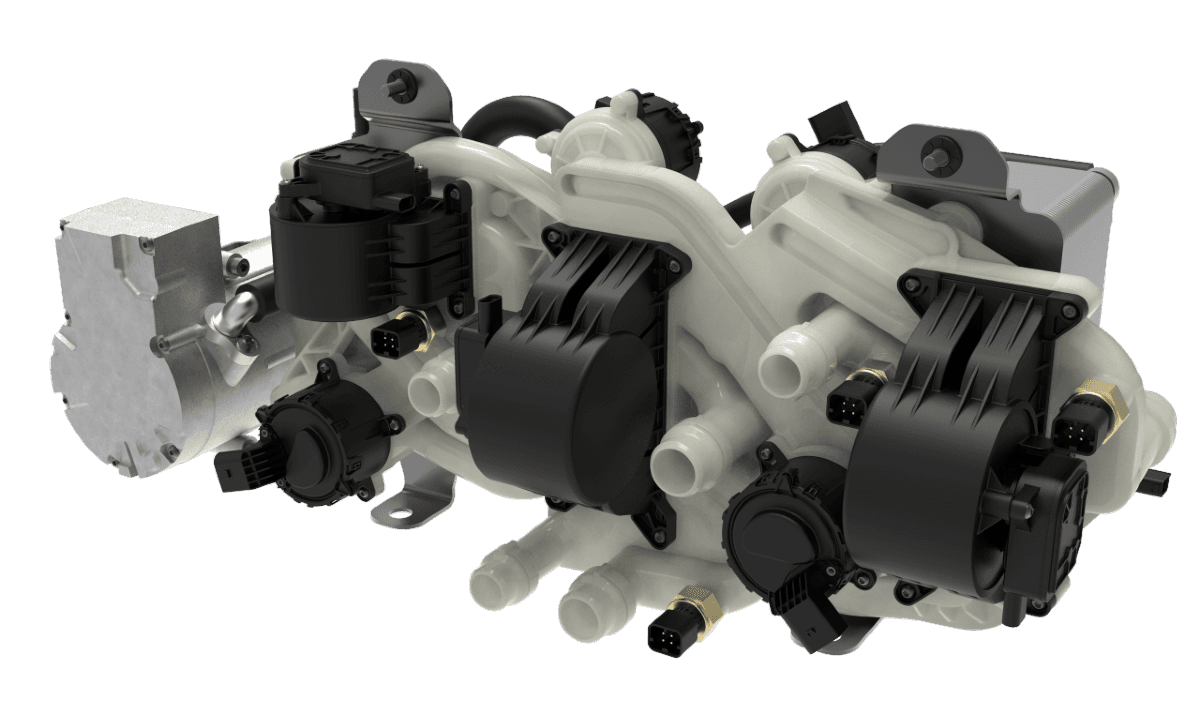
Ford Motor Company is taking steps to progress the development of propane (R290)-based thermal management systems for electric vehicles (EVs) in the U.S.
As the global shift toward low-GWP refrigerants accelerates, concerns are mounting over the widespread use of HFOs like R1234yf, the dominant refrigerant in EV thermal management systems. When R1234yf breaks down, it forms trifluoroacetic acid (TFA), a persistent PFAS (per- and polyfluoroalkyl substance) linked to environmental and human health risks. The European Chemicals Agency (ECHA) will meet in March to discuss proposed PFAS restrictions in f-gas applications.
In November 2024, Ford submitted an application to the U.S. Environmental Protection Agency (EPA) to list R290 as an acceptable option for mobile air-conditioning (MAC) and heat pump systems under the Significant New Alternatives Policy (SNAP) Program. R1234yf received SNAP approval in 2016.
The automaker’s application lists a propane-based secondary loop system as the alternative technology.
The Institute of Governance & Sustainable Development (IGSD), a U.S.-based environmental organization that has supported Ford’s efforts – alongside several other industry experts under the SAE International Thermal Management Refrigerant Cooperative Research Program – has urged the EPA to expedite approval of this “important application.”
“Most automobiles manufactured outside of Europe, North America and a few other developed countries still use HFC-134a,” Kristen Taddonio, Senior Technical Advisor to IGSD, told NaturalRefrigerants.com. “However, this will soon change thanks to the Kigali Amendment to the Montreal Protocol. As manufacturers evaluate their low-GWP refrigerant options, it is good to have additional options to compete with HFO-1234yf.”
“The new R290 in secondary loop architecture will safely cool and heat electric vehicle occupants while increasing electric vehicle driving range, which is key to satisfied customers,” she said in the IGSD’s statement about Ford’s SNAP application.
“As manufacturers evaluate their low-GWP refrigerant options, it is good to have additional options to compete with HFO-1234yf.”
Kristen Taddonio, Senior Technical Advisor to IGSD
The SNAP Program tasks the EPA with evaluating substitutes for ODS and HFCs targeted by the American Innovation and Manufacturing (AIM) Act. This program is designed to identify safer alternatives to reduce environmental and health risks. From 2025, MAC systems in light-duty passenger vehicles must use refrigerants with a GWP of 150 or less, under the act’s Technology Transitions rule.
The EPA has previously advised against the use of propane in MAC applications due to its flammability.
To date, CO2 (R744) has been the only natural refrigerant used in commercially available EVs. The Volkswagen Group offers R744 heat pump systems on its modular electric drive matrix platform, which underpins several vehicles, including the Audi Q4 e-tron and Electric Ford Explorer.
NaturalRefrigerants.com has contacted Ford for an update on progress with the SNAP approval process and its product development.
Ford’s research
Research conducted by Ford has identified R290-based full-secondary loop heat pumps as a superior solution for EVs, offering significant performance benefits compared to other technologies.
In secondary loop systems, the propane is restricted to the primary refrigerant loop, keeping it out of the passenger compartment, which is served by the system’s secondary loop using water or glycol. In addition to removing the flammable refrigerant from the passenger compartment, this design also minimizes the amount of refrigerant required in the system, further improving safety.
Ford’s study compared air-to-air direct expansion systems, water-to-water semi-secondary loop systems and water-to-water full-secondary loop systems. Its findings were presented by Angelo Patti, Product Development Engineer for Vehicle Thermal Systems at Ford, at the ATMOsphere (ATMO) MAC Summit 2024 × TU Berlin in September. The ATMO MAC Summit was co-hosted by ATMOsphere, publisher of NaturalRefrigerants.com.
The study was conducted in partnership with DENSO. Beyond assessing various system architectures, it also examined the benefits of R290 over R1234yf.
Testing showed that an R1234yf-based full-secondary loop heat pump with a vapor injector is 20% more efficient than a direct expansion system using the same refrigerant. However, replacing R1234yf with R290 in the system improves efficiency by 5% in heating mode and 29% in cooling mode.
Propane also significantly reduces compressor speed and enables fast charging due to its ability to maintain battery temperature, Patti explained.
“R290 is the best global option for BEVs [battery electric vehicles] if safety is addressed,” said Patti.
R1234ze
In a recent presentation delivered at the Thermal Management For EV/HEV 2025 conference held in Munich, Patti shared additional research comparing R1234yf with R1234ze, a low-GWP HFO that produces TFA from less than 10% of its emissions. The PFAS restriction proposal currently under review by the ECHA classifies R1234ze as a PFAS.
While R1234ze is better than or equal to R1234yf in terms of flammability, safety and environmental properties, the former’s boiling point is slightly higher, making its thermal dynamic properties unsuitable for heat pump applications, he explained.
“There’s lower performance with R1234ze, [so] we don’t think it’s a global solution,” he noted. Its use would also require a derogation in the EU and SNAP approval in the U.S.
Patti said that R1234yf is needed for EVs until R290 is approved and its safety issues are resolved.
“We definitely feel that R290 is the best option,” he added. “Ford started looking at R290 before the PFAS ban was announced. There are benefits to R290 besides the fact that it’s not a PFAS; it is a more efficient, lower cost refrigerant.”
“It is also a good option for secondary loop architecture,” he concluded.
“We definitely feel that R290 is the best option. Ford started looking at R290 before the PFAS ban was announced. There are benefits to R290 besides the fact that it’s not a PFAS; it is a more efficient, lower cost refrigerant.”
Angelo Patti, Product Development Engineer for Vehicle Thermal Systems at Ford