The European Commission, via the European Innovation Council, has provided €3.9 million ($4.45 million) in funding for the SMACool Project, which aims to develop a residential air conditioner using elastocaloric technology.
The SMACool project uses nickel-titanium, also known as nitinol, instead of a refrigerant. Nitinol is known as a shape memory alloy (SMA) because of its ability to be deformed but “remember” and return to its original shape after being heated.
Another unique property of nitinol is that it heats up when mechanical stress is applied to it, such as when it’s stretched or compressed, and cools down once the stress is relieved. This process can cause nitinol to reach a lower temperature than before it was stressed, which enables it to absorb heat from the air or a water-glycol mixture or transfer heat to it during the stressing process.
The SMACool project runs until September 2027, and its goal is a functioning prototype that delivers comfort heating and cooling via a building’s ventilation system. The unit under development will be “compact” and designed to cool/heat a single room, according to Paul Motzki, the leader of the SMACool project and Professor at Saarland University and the head of the school’s Smart Materials Research team.
“Elastocalorics functions as both a heat pump and a cooling system,” Motzki said in an interview with Saarland University. “The efficiency of elastocaloric materials is more than 10 times that of today’s air conditioning or heating systems. With the process planned in this project, we will achieve temperature differences of around 20°C [36°F] for both cooling and heating.”
The SMACool team also includes researchers from the University of Naples Federico II in Italy, the University of Ljubljana in Slovenia and the Irish company Exergyn, which is developing a heat pump that uses nitinol.
Initial efforts
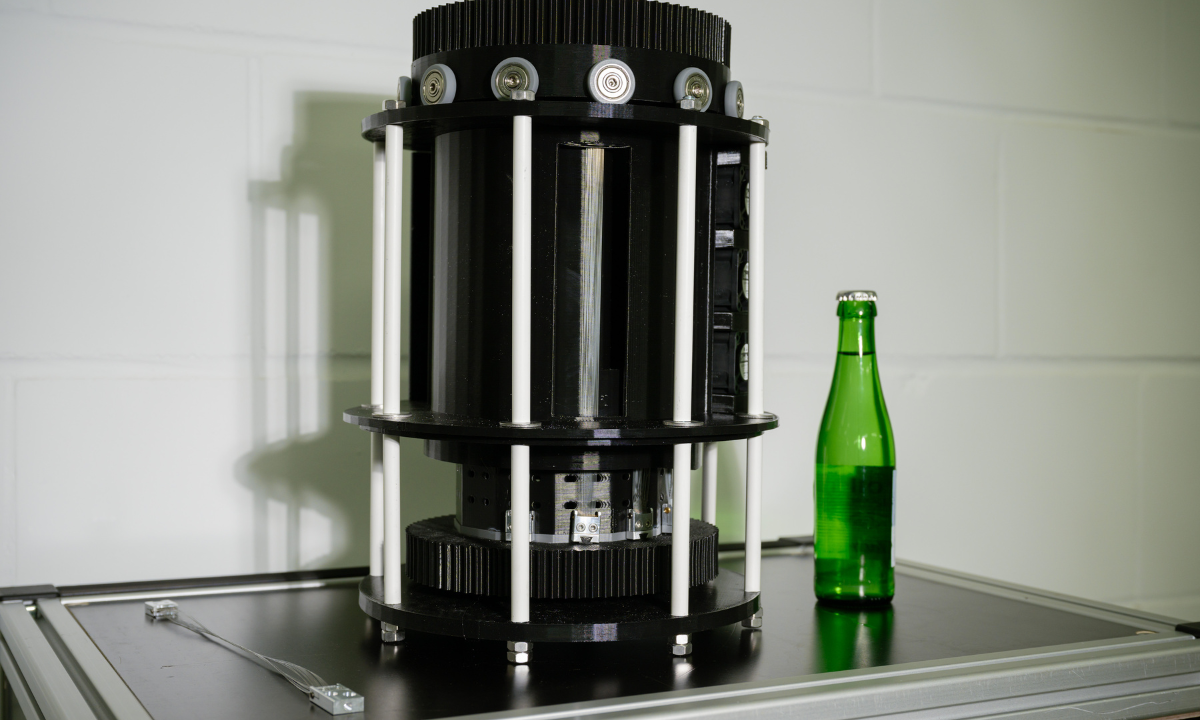
The University of Saarland’s Smart Materials Research team has developed a mini fridge using elastocaloric technology that can cool a small can or bottle. Sheets of nitinol wire, each as thin as a strand of human hair, are bundled together and rotated around a circular cooling chamber. The wires are stretched on one side and released on another, with air flowing through the side of the chamber where the wires are released. The cooling chamber can reach temperatures of 10–12°C (50–53°F). The elastocaloric mini fridge was shown at the 2024 Hannover Messe, an industrial innovation conference held in Hannover, Germany.
Exergyn has developed a prototype heat pump, the L12, that hydraulically compresses stacks of nitinol plates. The L12 has a heating capacity of 60kW (17TR), per a video released in 2022, and is still currently under development. Exergyn is headquartered in Dublin. It raised a $35 million (€30.8 million) funding round in 2022 and received a €15 million ($17.1 million) investment from Carrier Global Corporation in December 2024.