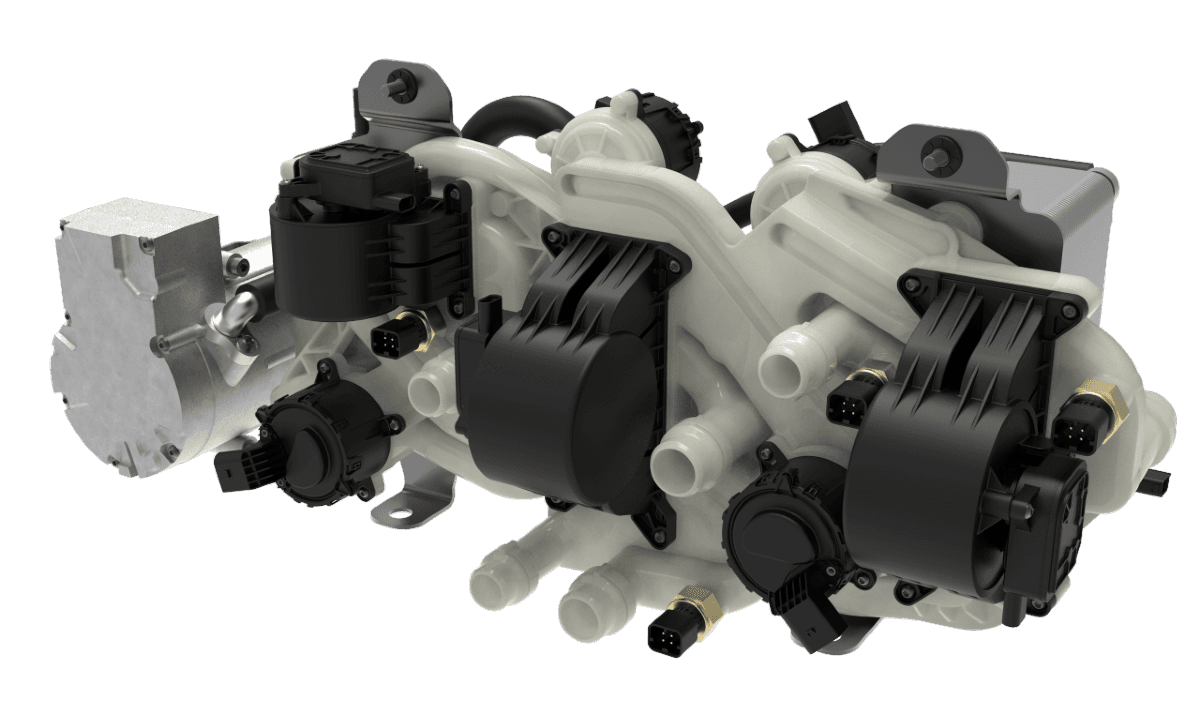
Shanghai Highly, a Chinese manufacturer of compressors for stationary and mobile HVAC applications, has announced that mass production of its propane (R290)-based integrated thermal management module for electric vehicles (EVs) – built around a scroll compressor – will begin in 2026.
The company is also developing a second version of the module featuring a vertical R290 rotary compressor aimed at further improving efficiency, reliability and cost, according to Zhou Yi, Chief Technology Officer at Shanghai Highly Electrical Appliances.
Yi outlined these plans during a technology case studies session at the ATMO MAC Summit 2025 × TU Berlin, held September 23–24. The conference was hosted by ATMOsphere, publisher of NaturalRefrigerants.com, in partnership with Technische Universität (TU) Berlin’s Department of Heat Transfer and Heat Conversion and took place on the university’s campus.
Lightweight, high capacity
Shanghai Highly’s scroll compressor module delivers roughly 10kW (2.8TR) of cooling at 50°C (122°F), sufficient to meet the fast-charging battery demands of large passenger vehicles. It also offers 7kW (2TR) of heating capacity at −30°C (−22°F),
Weighing just 13kg (28.7lbs), the module contains the propane compressor, chiller, water-cooled condenser, controller, e-expansion valve and sensor. Around 10% lighter and more compact than competing products, it offers cost savings and improved control, Yi added.
Ahead of mass production, Shanghai Highly has conducted extensive testing and simulations, confirming a COP of 1.65–2.33 under varying conditions.
Rotary compressors for EVs
EV thermal management systems have traditionally relied on scroll compressors for their compact design and quiet operation. However, rotary compressors can deliver higher efficiency and lower costs, according to Yi.
“In view of the advantages of rotary compressors, our company has begun to develop a rotary compressor for EVs,” he explained.
Alongside its work on an R290 rotary compressor, Shanghai Highly is preparing to launch its first CO2 (R744) rotary compressor for EVs. The unit has a 6.5cc displacement, weighs 6.9kg (15.2lbs) and achieves a COP of up to 3.8 with a cooling capacity of 7.3kW (2.1TR).
“Rotary compressors exhibit excellent performance comparable to scroll,” he added.
To further optimize R290 rotary compressor performance, the company has developed new oil return structures that cut the oil carryover rate (OCR) to below 1%. Previously the OCR exceeded 3%, which reduced heat exchanger efficiency, Yi noted.
“Rotary compressors exhibit excellent performance comparable to scroll.”
Zhou Yi, CTO at Shanghai Highly Electrical Appliances
While Shanghai Highly is just beginning its development of natural refrigerant-based rotary compressors for EVs, the company has been producing the technology for stationary HVAC applications for many years. Its first R290 rotary compressors entered mass production in 2019, followed by R744 models in 2022.
Today, the manufacturer produces around 50 million rotary compressors annually across a range of refrigerants.
China’s MAC market
Driven by ambitious regulations announced earlier this year, China is set to lead the transition to natural refrigerants in EVs, according to automotive intelligence company S&P Global Mobility.
From July 1, 2029, new car mobile air-conditioning (MAC) systems in China must use refrigerants with a GWP of 150 or lower. This ruling effectively prohibits the use of R134a, which has a 100-year GWP of 1,530, and opens the market to CO2 and R290 systems.
With this deadline approaching, Chinese OEMs are expected to roll out natural refrigerant-based EVs over the next few years, Yi noted.