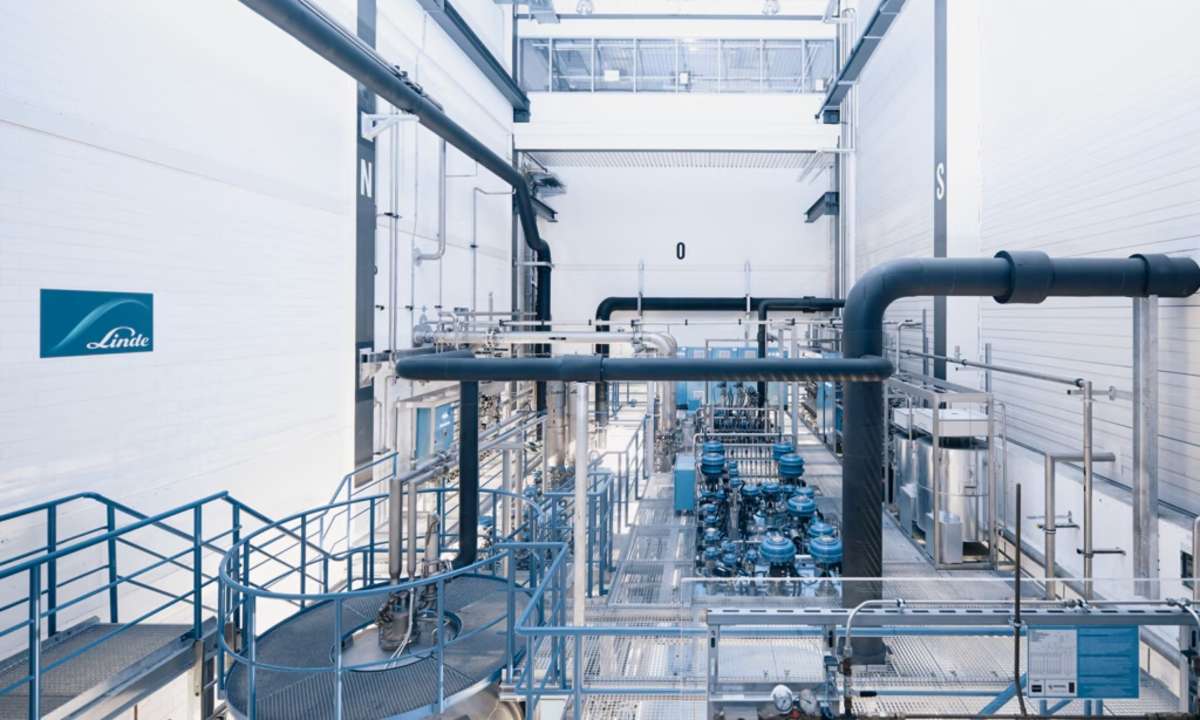
The world’s first “utility-scale” quantum computer, currently under development by California-based technology company PsiQuantum, will be supported by a helium (R704) cryogenic cooling system, according to a statement from the system’s manufacturer, Linde Engineering.
The natural refrigerant-based cryogenic plant will provide temperatures as low as −269°C (−452°F) and will be one of the largest such systems ever built specifically for quantum computing, Linde noted.
Utility-scale quantum computing refers to the ability of quantum computers to consistently solve problems that are relevant to scientific research or commercial endeavors. The deployment of such quantum computers is still in its early stages, with previous systems being primarily smaller and experimental. The technology is expected to transform industries such as healthcare, energy, materials design and encryption.
Once operational, the system will cool cabinets housing tens of thousands of PsiQuantum’s Omega chips, as well as other supporting infrastructure. Unlike traditional computer chips that use electrons, PsiQuantum’s Omega chips perform calculations using light particles (photons).
“Photons don’t feel heat the way matter-based qubits [quantum bits] do,” said Jeremy O’Brien, CEO and Co-Founder of PsiQuantum. “Our systems can run 100 times warmer, and we appreciate collaborating with a world-class firm like Linde Engineering to deliver industrial-scale systems with proven technology. This is a key reason we are able to move rapidly toward utility-scale quantum computing.”
The quantum computer will be built in Brisbane, Australia, and is expected to be operational by the end of 2027. PsiQuantum has also announced plans for a similar facility in Chicago.
Cryogenic cooling
Cryogenic cooling is used in applications that require temperatures below −150°C (−238°F), often approaching absolute zero at −273.15°C (−459.67°F). These ultra-low temperatures are essential for technologies like particle accelerators — such as the Large Hadron Collider at CERN in Geneva – medical imaging, semiconductors, aerospace research and quantum computing.
Helium’s physical properties, including its superfluidity at extremely low temperatures, makes it ideal for these applications, Linde told NaturalRefrigerants.com.
“Below −196°C [−321°F], only helium, hydrogen and neon remain gaseous at ambient pressure, and only helium remains gaseous below −253°C [−424°F],” explained Markus Drewes, PR Coordinator at Linde. In applications where helium, hydrogen and neon are viable, helium is often preferred due to its safety and wider availability, he noted.
“At such low temperatures, helium is the only element that meets the physical requirements for a refrigerant,” he added.
“Below −196°C [−321°F], only helium, hydrogen and neon remain gaseous at ambient pressure, and only helium remains gaseous below −253°C [−424°F].”
Markus Drewes, PR Coordinator at Linde
“This technology will help design solutions to address some of the most pressing challenges faced by society today,” said John van der Velden, Senior Vice President Global Sales and Technology for Linde Engineering.
To date, Linde Engineering has installed more than 500 cryogenic plants, around 90% of which use helium. While best known for ultra-low temperature cooling, helium can also be used in high-temperature heat pumps.
Cooling quantum computers
In quantum computing, cryogenic cooling is vital to keep qubits stable and prevent errors caused by heat and sound.
“Qubits are susceptible to interactions with their environment and cannot function reliably without appropriate cooling, which maintains qubits in a state where they preserve their quantum mechanical properties,” explained Linde.
Unlike regular binary computer bits, qubits can exist in multiple states at once, enabling them to perform many calculations simultaneously. This gives quantum computers the potential to solve certain complex problems far faster than traditional computers.
“This technology will help design solutions to address some of the most pressing challenges faced by society today.”
John van der Velden, Senior VP Global Sales and Technology for Linde Engineering