This is an excerpt from an article featured in ATMOsphere’s “Clean Cooling for Data Centers 2025” report, which can be downloaded here. ATMOsphere is the publisher of NaturalRefrigerants.com.
SWEP, a global manufacturer headquartered in Landskrona, Sweden, has been producing brazed plate heat exchangers (BPHEs) since 1983. A subsidiary of the Dover Corporation since 1994, the company operates five production facilities across three continents and maintains entities in more than 20 countries. In 2023 alone, the company produced and sold more than 3.5 million BPHEs worldwide. SWEP’s products are designed for efficient heat transfer across a wide range of sectors, including comfort cooling, power generation, industrial manufacturing and data centers.
“We have been working with heat recovery for many years with applications like power generation and combined heat and power [CHP] systems, steel mills and paper mills,” said Christer Frennfelt, Business Development Manager at SWEP. “Now we have another heat source to work with: data centers.”
SWEP’s BPHEs are compact and efficient, allowing customization through plate count, configuration and thermal optimization. Using the company’s SSP DThermX software, customers can input precise thermal and hydraulic requirements to identify the ideal solution for their application.
The high thermal efficiency and compact design of SWEP’s BPHE technology make it ideal as an intermediate circuit, effectively separating external glycol loops from internal server cooling systems. Their compactness is designed to enable modular setups, providing reliability, improved part-load efficiency and cost-effective redundancy – all vital characteristics for data center systems.
Liquid cooling
As thermal demands evolve – especially with AI driving higher rack densities – SWEP is developing multiple new BPHE models tailored for next-generation coolant distribution units (CDUs) and immersion systems.
“We’re seeing data centers moving from 30–33°C [86–91°F] for storage to 45–60°C [113–140°F] for AI workloads,” Frennfelt said. “We need a range of specially made heat exchangers for these CDU racks.”
One of SWEP’s new designs features asymmetric channels, where one side accommodates high-viscosity immersion fluids while the other handles low-viscosity water, optimizing flow and minimizing pressure drop. Upcoming products also focus on material efficiency, using fewer plates to reduce footprint while maintaining performance.
“Our brazed plate heat exchangers are compact and very efficient, which is a good match for the CDU systems, where space is often a constraint,” he added.
As computing demands surge, air cooling is becoming insufficient for high-density racks. Water, being 25 times more effective at transferring heat and capable of handling four times the cooling capacity of air, has emerged as the preferred medium, according to SWEP.
This shift toward liquid cooling not only enables greater computing density and efficiency but also opens the door to heat recovery, turning what was once waste into a valuable energy resource. “Excess heat used to be something data centers wanted to get rid of,” Frennfelt said. “Today it’s business.”
Heat recovery
SWEP supports this transition with a comprehensive range of heat exchangers designed for CDUs, offering solutions for water- or brine-based systems with inlet temperatures around 25°C (77°F) and up to 55°C (131°F) for propylene glycol. These systems capture excess heat from data centers, which can then be raised and reused via heat pumps in district heating networks to warm homes, businesses and swimming pools and even to support agricultural developments.
This is already a reality in several countries, particularly across Europe, where district heating networks are relatively common. In one example, SWEP’s BPHEs connect a hyperscale data center to the city’s heating grid.
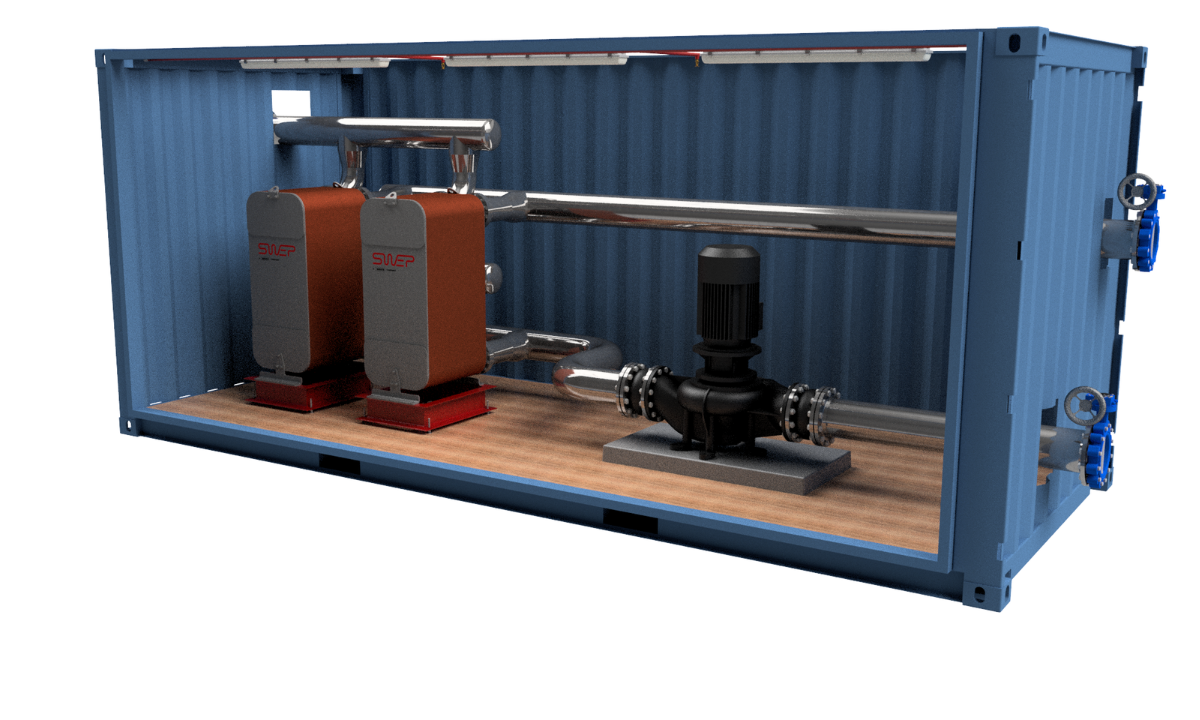
The installation consists of multiple 40-foot (12.2-meter) containers, each housing two heat exchangers, pumps and piping and recovering 10MW (2,843TR) of heat at 35–40°C (95–104°F), which is then boosted to 90–95°C (194–203°F) for district heating use. Similar initiatives are expanding in the U.K. and U.S., where recovered heat is used in agriculture, leisure centers and industry. As heat reuse regulations tighten, particularly in Europe, data centers are rethinking their thermal management strategies to comply and capitalize on heat recovery.
Immersion cooling is emerging as another powerful and efficient alternative for heat management, and SWEP is actively exploring its potential, noted Frennfelt. Although the technology has existed for several years, real market interest is only now accelerating.
SWEP’s work in immersion cooling is still in its early stages. It has several ongoing test projects in collaboration with leading system manufacturers covering both single- and two-phase solutions.
“Excess heat used to be something data centers wanted to get rid of. Today it’s business.”
Christer Frennfelt,
Business Development Manager at SWEP