Japanese HVAC&R manufacturer Daikin has added CO2 (R744) to its range variable refrigerant flow (VRF) systems, dubbing it the “best available refrigerant” for the technology in an interview with NaturalRefrigerants.com at ISH 2025.
Daikin announced the launch of its new CO2-based VRV (variable refrigerant volume) system – the company’s trademark for VRF – at the end of 2024. Daikin previously offered R410A and R32 VRF systems. However, as the EU phases out HFCs in new equipment by 2050 and looks to tighten regulations on HFOs, natural refrigerants like CO2 offer the sector a future-proof alternative, explained George Dimou, VRV Product Manager at Daikin Europe.
“We are investigating all possible refrigerant alternatives for our product,” he said. “R32 is not a long-term solution; we need to find another refrigerant, [and] CO2 is a good future alternative for the European market.”
The adoption of these technologies will also support Daikin’s efforts to achieve carbon neutrality by 2050, he added.
In addition to CO2, the company explored propane (R290) and HFO R454C but ruled them out due to issues like flammability.
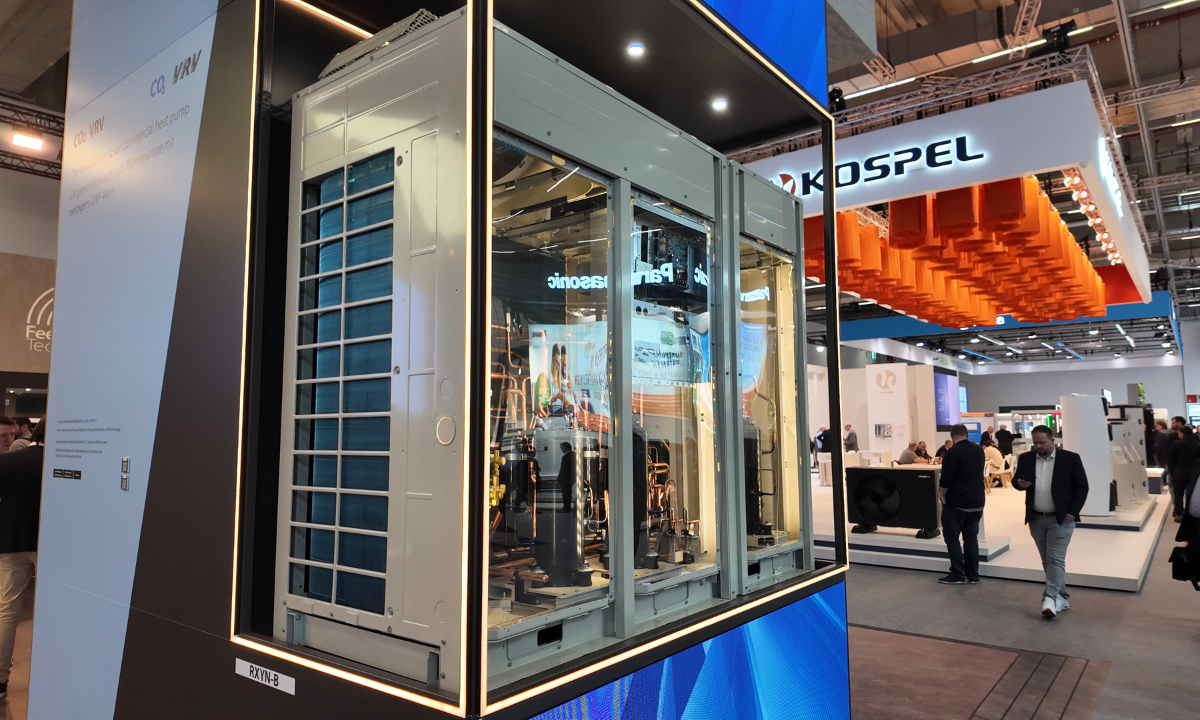
Daikin showcased its new CO2 VRV unit, alongside several other natural refrigerant products – including its new commercial R290 heat pump – at ISH 2025, which took place in Frankfurt from March 17–21.
Suited for supermarkets
The 10HP air-to-air direct expansion (DX) unit is designed for commercial HVAC applications, offering 28kW (8TR) of nominal capacity for both heating and cooling. It has a seasonal efficiency rating of 4.8 for cooling and a seasonal COP of 3.5 for heating, explained Dimou.
While the technology is suitable for various applications, it is a particularly good fit for supermarkets due to the sector’s familiarity with CO2 as a refrigerant, he noted. It is also better suited for new-build projects rather than retrofits, as these would generally require a complete renovation of a building’s HVAC system.
The unit will be commercially available from June 2025, and Dimou said the company is already seeing “big interest” in the technology.
“There’s also very big interest from our competitors, which is a good sign,” he noted.
R744 vs. R32
R32 and R410A VRF technologies are relatively mature compared to CO2 and benefit from years of development, explained Dimou. As such, these systems are generally more efficient and smaller, he said. For example, Daikin’s new CO2 VRV unit weighs around 500kg (1,100lbs), while an R32 unit of comparable capacity is closer to 290kg (640lbs).
“For R32 and R410A, the technology has been optimized,” he said. “We wanted to start by developing the [CO2] system, working together with other market stakeholders [like] installers [and] parts manufacturers.”
“We’re now looking to see applications and challenges in real life and gain more expertise, experience and knowledge,” he added.
Daikin had previously developed a VRF system with R744 back in 2010, but the technology was vastly different to its new VRV unit, and the market was not yet ready for it, he noted.
“We are investigating all possible refrigerant alternatives for our product. R32 is not a long-term solution; we need to find another refrigerant, [and] CO2 is a good future alternative for the European market.”
George Dimou, VRV Product Manager at Daikin Europe