ATMOsphere, publisher of NaturalRefrigerants.com, has projected that emissions of f-gas refrigerants (mostly HFO-1234yf) from mobile air-conditioning (MAC) and thermal management systems in Europe will cause annual levels of trifluoroacetic acid (TFA) in the atmosphere to quadruple to about 8,000 metric tons between 2015 and 2034.
ATMOsphere data also showed that cumulative levels of TFA generated from emissions of f-gases from cars in Europe will increase to 600% of 2015 levels by 2050 and then level off. The company expects the average amount of TFA found in rainwater in Germany in 2014 (340ng/L) will almost triple to about 1,000ng/L by 2034 before falling back to 340ng/L in 2045.
TFA levels in Europe will decline as electric car manufacturers gradually switch to natural refrigerants like CO2 (R744) and propane (R290) in electric vehicles.
These results are based on a scenario in which PFAS refrigerants will be restricted in 2035 and 2042 in different drivetrain systems in the EU, and new internal combustion engine (ICE) cars will be banned in 2035.
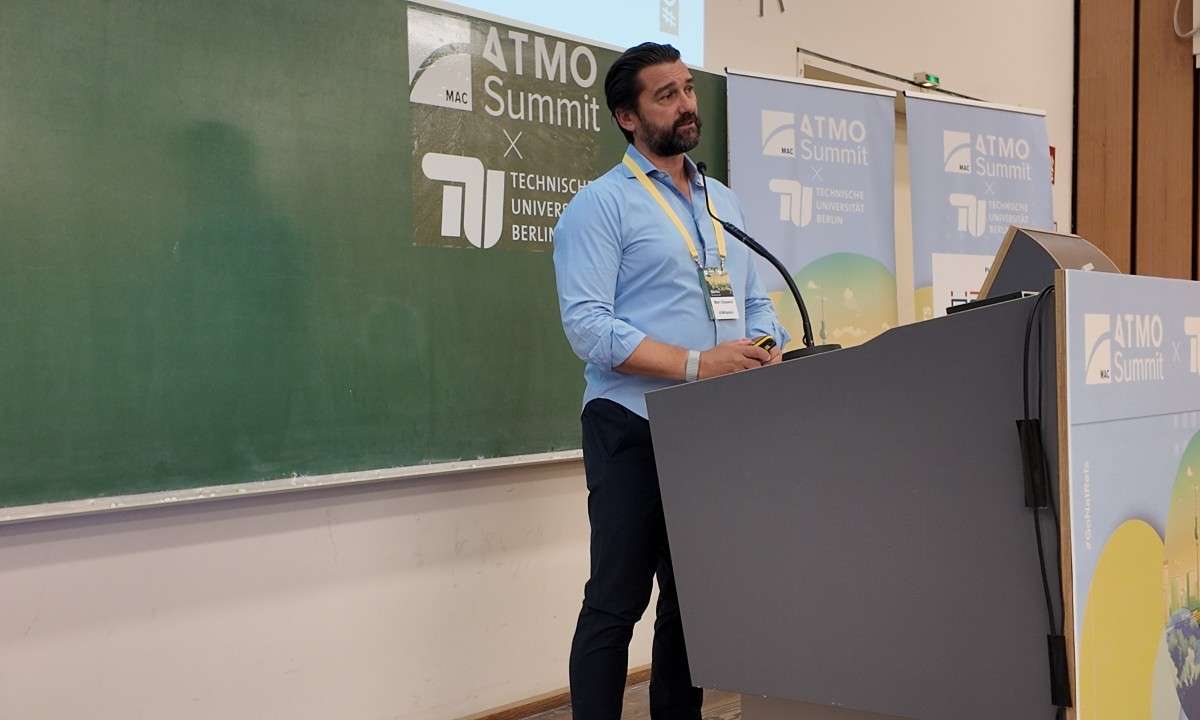
The findings were announced by Marc Chasserot, CEO of ATMOsphere, at the ATMO MAC Summit 2025 × TU Berlin. The event, held September 23 to 24, was organized by ATMOsphere and Technische Universität (TU) Berlin’s Department of Heat Transfer and Heat Conversion and took place on the university’s campus.
“Our model calculates the TFA emissions [stemming] from the MAC systems of the entire passenger car fleet in circulation in Europe today” and projects emissions up to 2055, said Chasserot. “We use conservative estimates, which means that the actual concentrations might be higher.” Data was obtained from multiple sources, including the European Automobile Manufacturers’ Association (ACEA) and interviews with industry suppliers.
The model encompasses the following:
- A refrigerant charge of 500g.
- Refrigerants considered included: HFC-134a, HFO-1234yf, CO2 and propane.
- Annual leakage rates of 5% for mechanical compressors, 3% for electrical compressors and 3% for crashes.
- A vehicle life of 15–21 years.
- Drivetrain configurations included internal combustion engine (ICE) with mechanical compressors, hybrid electric vehicle (HEV) with mechanical compressors, plug-in hybrid electric vehicle (PHEV) with electric compressors and battery electric vehicle (BEV) with electric compressors.
- A European vehicle fleet of about 350 million through 2055.
HFO-1234yf was introduced as a replacement for HFC-134a as a refrigerant in MAC systems for ICE cars in Europe in about 2012 and has since gained dominant market share. Both gases are now used in ICE cars and HEV, while HFO-1234yf is also used in PHEV and BEV; CO2 and propane are only used in PHEV and BEV.
Conversion to TFA
Both HFO-1234yf and HFC-123a, when they leak into the atmosphere, change into TFA, though HFC-134a converts up to 20% while HFO-1234yf undergoes 100% conversion. HFO-1234yf, HFC-134a and TFA are categorized as ultrashort-chain PFAS (per-and polyfluoroalkyl substances), a group of industrial chemicals that includes many environmental pollutants.
TFA is absorbed in rainwater and is distributed throughout the global environment, entering drinking water, food and human blood. Its health effects are still being evaluated, though the German government has asked the EU to classify it as reproductively toxic.
TFA has other environmental precursors besides f-gases, such as certain pesticides, pharmaceuticals and other PFAS, but f-gases, particularly HFO-1234yf, are regarded as the primary source of TFA in the environment. A new study by Canadian researchers has found that the amount of TFA in the atmosphere is greatest in the summer and near urban areas, consistent with the leakage of HFO-1234yf from MAC. In addition to MAC systems, HFO-1234yf is used in many refrigerant blends found in commercial and industrial applications.
Growing market for natural refrigerants
While natural refrigerant-based MAC systems currently represent a small percentage of the market, over the next 30 years the market is expected to move toward CO2 and propane in PHEV and BEV and ultimately in only BEV, according to the ATMOsphere analysis.
For example, automotive thermal management supplier Hanon Systems recently announced that it has produced more than 1 million CO2 electric compressors for electric vehicles. “That’s big message,” said Chasserot. “CO2 is here, and it’s working.” These compressors are for PHEV and BEV.
In addition, automakers are showing “high interest” in propane (R290)-based thermal management systems for PHEV and BEV electric vehicles, according to Benedikt Schauder, Thermal Management Development Lead at ZF, a German automotive supplier. “There are propane providers that are coming in the next two to three years, and there’s going to be some real competition” with CO2 systems, said Chasserot.
In electric vehicles the thermal management system not only supplies comfort cooling and heating for passengers, but it also allows the battery to remain at optimal temperature (20–45°C/68–104°F) to charge faster.
Three scenarios
In its analysis of f-gas emissions from MAC systems, ATMOsphere incorporated restriction option (RO) 2 in the recently updated EU PFAS restriction proposal, which is still being negotiated. Under RO2, PFAS refrigerants in MAC systems in combustion engine vehicles with mechanical compressors have a 13.5-year total exemption (derogation), including the 1.5-year transition period, after the restriction enters into force (which is expected in 2028). PFAS refrigerants used in light-duty electrical vehicles (such as passenger cars and vans) have a 6.5-year total exemption.
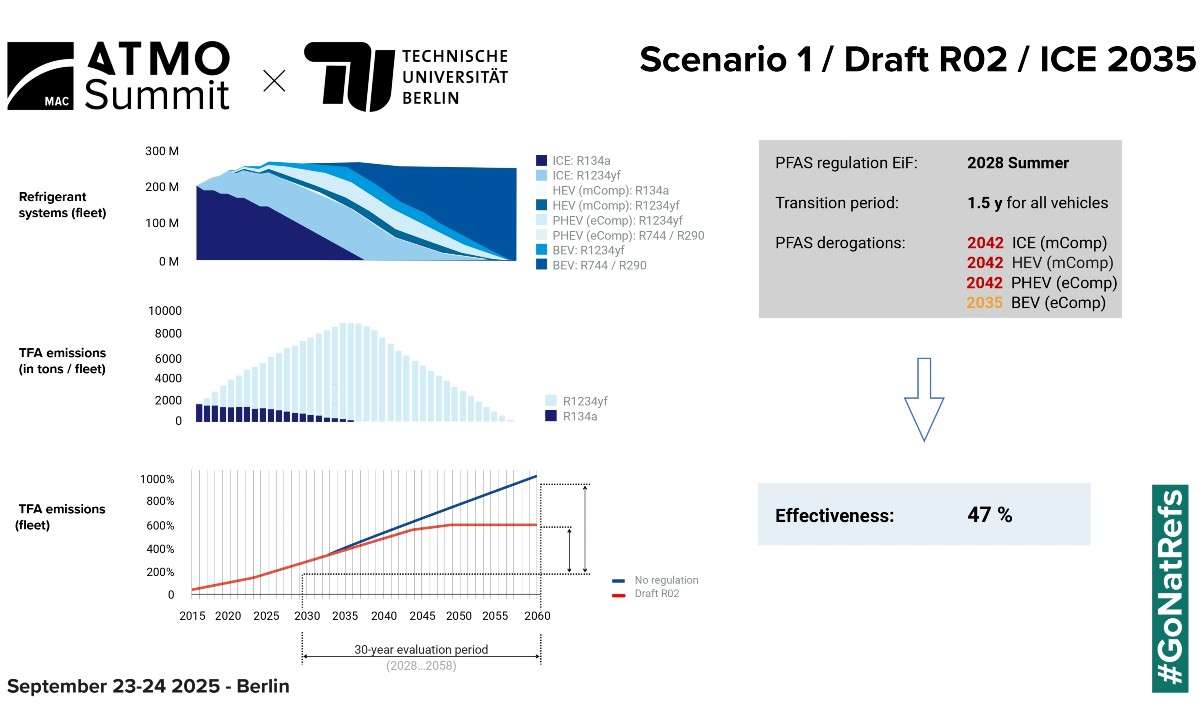
ATMOsphere looked at three potential scenarios with RO2: one where ICE cars are banned in 2035, a second where the ban is delayed until 2041 and a third where the 2041 delay is combined with more aggressive PFAS bans in electric cars. It determined a 47% effectiveness rate for scenario 1, 36% for scenario 2 and 46% for scenario 3. Those are all well below the minimum effectiveness threshold of 70% for eliminating persistent chemicals in the EU. “How to fix that is the challenge for policymakers and industry over the next 12 to 24 months,” said Chasserot.
In scenario 1, PFAS restrictions enter into force in 2028 and exemptions end for BEV in 2035 and for ICE, HEV and PHEV in 2042. Scenario 2 assumes a delay of the ICE ban until 2041 and maintains the exemption periods. Scenario 3 assumes a delay of the ICE ban until 2041 but shortens the exemption periods for BEV to 2030 and PHEV to 2035.
Under scenario 1:
- Annual TFA generated by HFO-1234yf (mostly) and HFC-134a, beginning at 2,000 metric tons in 2015, is projected to grow to a peak of 8,000 metric tons in 2034 then decline to 2,000 metric tons in 2050.
- Cumulative levels of TFA are projected to increase by 600% between 2015 and 2050.
Scenario 2 delays the reduction of TFA by about five years, but scenario 3 returns to the scenario 1 schedule.
Several European countries have issued guidelines for acceptable levels of TFA in drinking water. Germany has set a health-based guideline value of 60mcg/L for TFA in drinking water and a “precautionary measure” of 10mcg/L. Denmark has set a TFA drinking water threshold of 9mcg/L, while the Netherlands has listed the lowest drinking water advisory, 2.2mcg/L. Italy recently imposed a limit of 10mcg/L for TFA.
In the EU as a whole, the recast Drinking Water Directive will limit “PFAS total” (including TFA) in drinking water to 0.5mcg/L as of January 12, 2026; member states can use this or a 0.1mcg/L limit for 20 specific PFAS, not including TFA.
“We use conservative [TFA] estimates, which means that the actual concentrations might be higher.”
Marc Chasserot, CEO of ATMOsphere