German automaker Volkswagen (VW) is working to improve the efficiency of its CO2 (R744)-based heat pump system for electric vehicles (EVs) and reduce material costs, according to Carsten Wachsmuth, who works in the automaker’s R&D division on EV thermal management.
Wachsmuth highlighted the work VW’s R&D team is doing in a presentation at the ATMO MAC Summit 2025 × TU Berlin. The event was hosted by ATMOsphere, publisher of NaturalRefrigerants.com, in partnership with Technische Universität (TU) Berlin’s Department of Heat Transfer and Heat Conversion and took place September 23–24 on the university’s campus. Wachsmuth was joined on stage by Johannes Schwerter, who also works in VW’s R&D division as a Test Engineer.
“Having sold roughly a million cars with an R744 thermal management system, we’ve learned a lot,” said Wachsmuth, who added that Volkswagen is applying the knowledge gained to cutting material weight, simplifying the system and streamlining production. “We are currently working with more than 17 international R744 technology experienced suppliers. The know-how is no longer concentrated in just a handful of companies.”
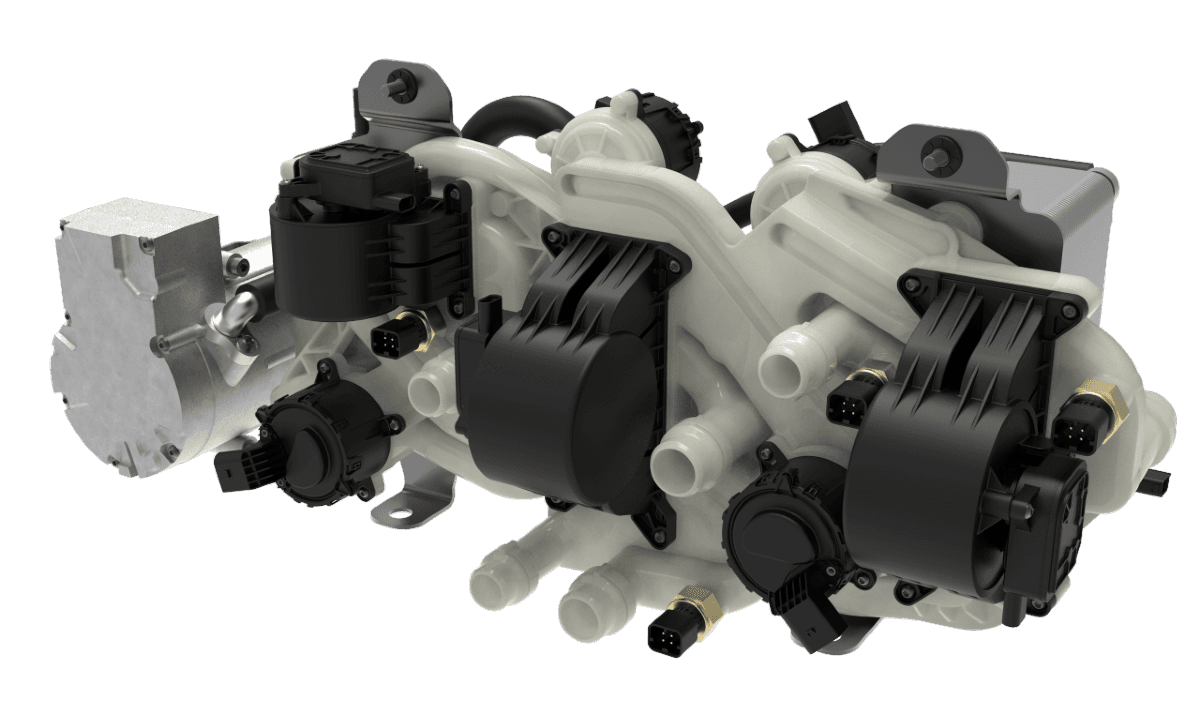
The company’s CO2 heat pump system sources heat from the vehicle’s drivetrain components, the ambient air or both. It features a 5.5kW (1.6TR) CO2 compressor manufactured by Hanon Systems. Volkswagen first offered CO2 heat pumps for EVs in 2020 in the ID.3 and ID.4.
Since 2020, the tech has been expanded across the growing ID range and brought to the company’s other brands, including Audi, Cupra and Škoda. The 2024 Electric Ford Explorer, which is built on VW’s EV platform, features a CO2 heat pump available as an optional extra. Volkswagen plans to further streamline the technology for inclusion in a future class of cost-sensitive models, including the ID.Polo and ID.Cross.
“Having sold roughly a million cars with an R744 thermal management system, we’ve learned a lot.”
Carsten Wachsmuth, Volkswagen’s R&D Division, EV thermal management.
Cutting material costs: Due to the higher pressures and temperatures of CO2, Schwerter indicated that VW over–designed its first generation of the CO2 thermal management system.
- “Our first CO2 compressor weighed 7.6kg [16.8lbs)]” said Schwerter. “We’ve now introduced a second version of the compressor that is a half kilogram [1.1lbs] lighter, bringing the weight to 7.1kg [15.7lbs].”
- The current system contains eight valves: three expansion valves controlling use of the evaporator and chiller and five shut-off valves for switching operational modes. “To cut weight and costs, we are looking into integrating several valves into one aluminum body and combining two single valves into one proportional valve,” Schwerter noted.
Manufacturing efficiency: The R744 system will share the same production line as vehicles equipped with the standard R1234yf system.
- The piping in both systems can use the same aluminum alloy with roughly the same wall thickness, with the R744 package requiring a smaller inner diameter, according to Schwerter.
- The R1234yf system includes an evaporator and a 6kW (1.7TR) PTC (positive temperature coefficient) heater to provide supplemental heat as needed. The R744 system includes an evaporator, gas cooler and a PTC heater. “To streamline the shared production line, a supplier preinstalls the R744’s valve unit,” Schwerter said.
- Increasing the manufacturing volume will further reduce the cost of the CO2 system.
Ice to meet you: VW is also changing the design of the gas cooler to address ice buildup caused by harvesting heat from ambient air.
- Strategies to prevent ice formation ‒ based on the difference (air gap) between the ambient temperature and evaporation temperature or the dew point temperature and the evaporation temperature ‒ failed to harvest more than 0.6kW (0.2TR) of heat in humid environments like those in Europe with a relative humidity of 88% at −7°C (19.4°F), according to Wachsmuth.
- “To extend the air gap, we should move from icing prevention to icing management,” he said.
- The vertical orientation of gas cooler tubes, instead of a horizontal one, allows melted frost to run off the unit, with active deicing of the heat exchanger enabling long-term operation.
Quotable: “Although it took five years to get our first million EVs on the road with CO2 thermal management, it should be much quicker to get the second million,” said Schwerter. “We already offer the heat pump in other markets besides Europe, including China and North America.”