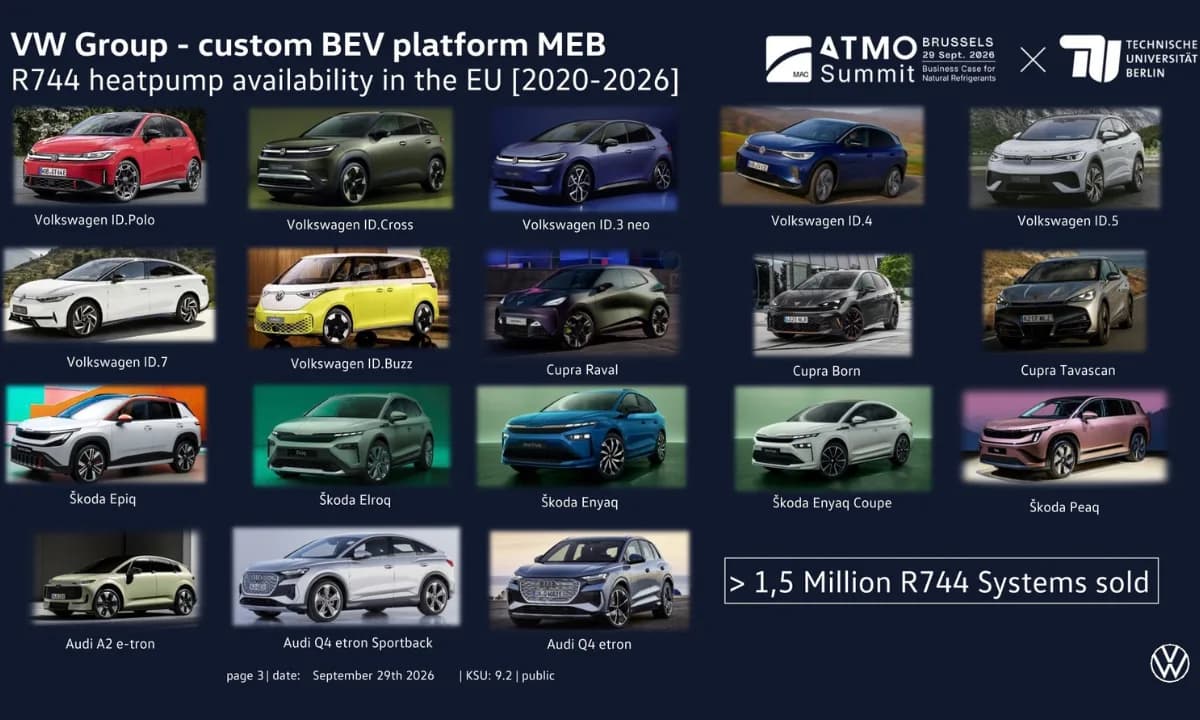
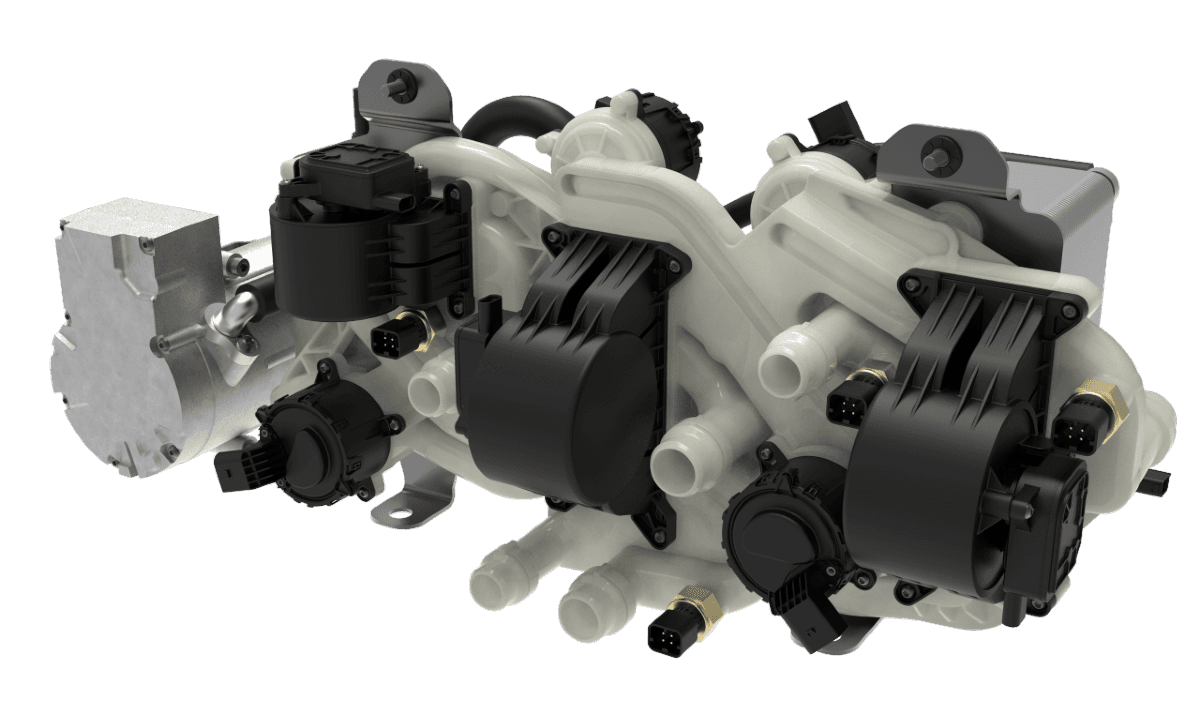
In-vehicle testing of thyssenkrupp Dynamic Components’ CO2 (R744) compressor for battery electric vehicles (BEVs) demonstrates high performance and efficiency across a wide range of operating conditions, including in ambient temperatures above 40°C (104°F), according to the manufacturer.
“With this system we show that it is feasible for a 6kg [13.2lb] CO2 compressor to continuously support an EV’s terminal management system,” noted Sebastian Wappler, Head of Product Platform Development at thyssenkrupp Dynamic Component, during a recent presentation of test data. “The CO2 compressor fulfills all future requirements for BEVs.”
The company’s testing and simulations indicate that the compact compressor offers long-term functional reliability, with high cooling power and optimal heat pump performance.
Wappler shared test data during a technology case studies session at the ATMO MAC Summit 2025 × TU Berlin, held September 23–24. The conference was hosted by ATMOsphere, publisher of NaturalRefrigerants.com, in partnership with Technische Universität (TU) Berlin’s Department of Heat Transfer and Heat Conversion and took place on the university’s campus.
Thyssenkrupp Dynamic Components is a division of German manufacturer thyssenkrupp Automotive Technology.
“With this system we show that it is feasible for a 6kg CO2 compressor to continuously support an EV’s terminal management system.”
Sebastian Wappler, Head of Product Platform Development at thyssenkrupp Dynamic Component
Market shifts
The shift towards EVs is transforming automotive thermal management systems, in part due to the additional cooling requirements of EV batteries, according to Wappler.
As internal combustion engines phase out, demand for advanced compressors suited to BEVs and plug-in hybrid electric vehicles (PHEVs) is growing rapidly. By 2031, BEVs and PHEVs are expected to capture around 31% and 25% of the global vehicle market, respectively.
At the same time, regulatory and environmental pressures – including the EU F-gas Regulation and proposed PFAS restrictions – are accelerating the transition from synthetic refrigerants to natural alternatives such as CO2 and propane (R290).
CO2 in particular offers several advantages as a refrigerant for EV thermal management, it is PFAS-free, low-GWP, non-toxic and non-flammable. It also offers simpler system architecture than some alternatives as it does not require a secondary refrigerant loop. However, R744-based technologies must also address challenges such as high operating pressure and lower COP at high ambient temperatures.
“Our goal was to develop a compressor for this challenge,” noted Wappler. “It is feasible to change from chemical refrigerants to natural refrigerants, and thyssenkrupp is a part of that transition.”
“It is feasible to change from chemical refrigerants to natural refrigerants, and thyssenkrupp is a part of that transition.”
Sebastian Wappler, Head of Product Platform Development at thyssenkrupp Dynamic Component
Demonstrated performance
Thyssenkrupp’s in-vehicle and bench tests have demonstrated that its CO2 compressor delivers an “excellent performance level over the entire operation range,” offering a more efficient thermal management map for future EVs, according to the company.
Testing has shown that the compressor efficiently operates across the complete temperature range with low energy consumption due to minimal power losses. It has demonstrated low oil circulation rate, stable operation under wet vapor inlet conditions and durability in long-term cycling tests. The compressor has also shown it can maintain a large mass flow spread within oil temperature limits.
“With this compressor we have seen very successful tests in different cases,” explained Wappler.
In cold-climate testing at −24°C (−11.2°F), an electric SUV equipped with the system maintained full functionality in heat pump mode. Continuous operation at high compressor speed enabled effective cabin heating even under extreme ambient conditions.
At the other end of the spectrum, road tests at over 40°C ambient confirmed the compressor’s ability to provide effective cooling for both the cabin and the battery. The R744 HVAC system, supported by a dedicated chiller for battery cooling, achieved 10°C (50°C) at the evaporator within a short period, even under solar load and high thermal demand during DC fast charging.
Further optimization of direct R744 systems could increase the system’s COP, particularly compared to indirect systems, where energy losses occur through intermediate condensation and evaporation processes, according to thyssenkrupp.
The company is now conducting continued testing and investigations to overcome the challenges presented by CO2-based thermal management systems in EVs, Wappler added.