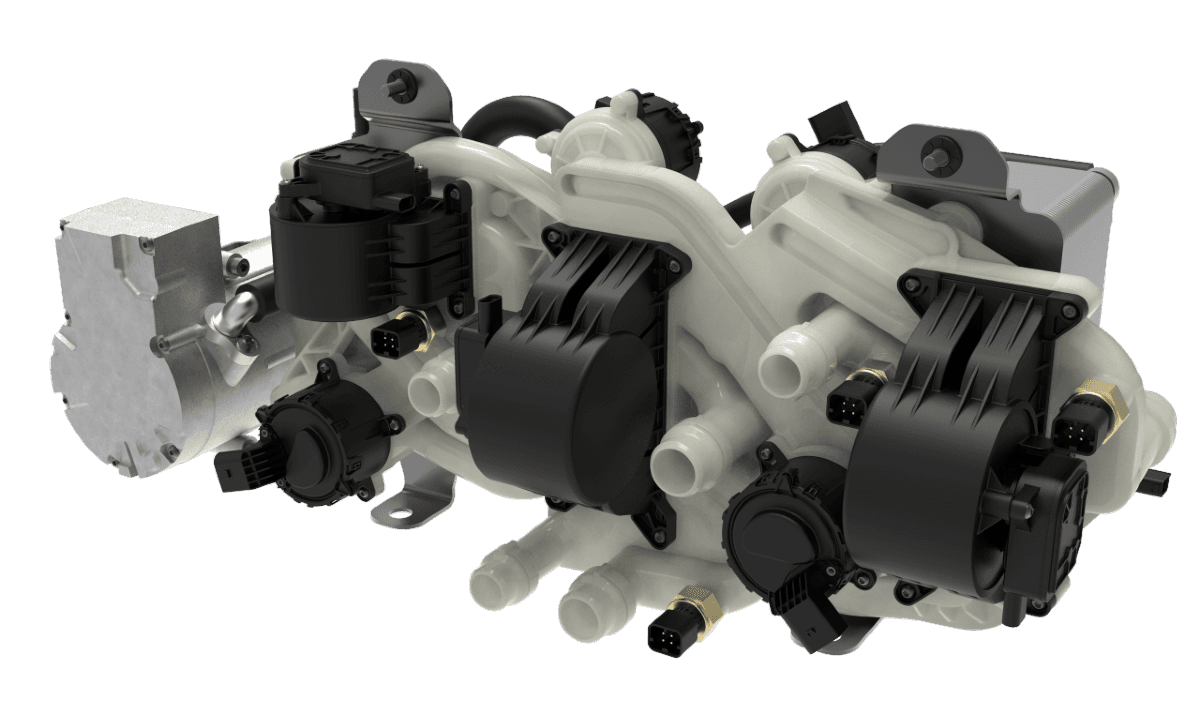
According to Professor Stefan Elbel, Head of the Department of Heat Transfer and Heat Conversion at Technische Universität Berlin (TU Berlin), natural refrigerants such as CO2 (R744) and propane (R290) are “critical” for the future of mobile air-conditioning (MAC) and heat pump systems.
Elbel shared his stance during a keynote given at the ATMOsphere (ATMO) MAC Summit 2024 × TU Berlin. ATMOsphere, the publisher of NaturalRefrigerants.com, organized the ATMO MAC Summit in partnership with TU Berlin’s Department of Heat Transfer and Heat Conversion. The event was held September 12–13 in Berlin.
During his presentation, Elbel emphasized that the industry must move away from searching for a “miracle fluid” that doesn’t exist and instead focus on addressing challenges with current refrigerants.
Why natural refrigerants: The shift toward CO2 and propane is driven by both environmental necessity and regulatory forces, Elbel stated.
- While the recently revised European F-gas Regulation primarily targets stationary refrigeration and heating systems, a proposed regulation restricting the manufacture, use or sale of PFAS (per- and polyfluoroalkyl substances) would help to drive the adoption of natural refrigerants in the automotive sector.
- R1234yf, an HFO and PFAS commonly used in automotive air-conditioning systems, would be banned under what has become known as the “Universal Restriction Proposal.” The European Chemicals Agency (ECHA) is currently reviewing the proposed PFAS regulation.
- The consulting firm Ducker Carlisle issued a white paper in May stating that it’s “highly likely” electric vehicle (EV) manufacturers will move from R1234yf to CO2 or propane in the next five years “due to stricter environmental legislation across industries.”
CO2 in MAC systems: Elbel discussed strengths and weaknesses of CO2 as a refrigerant in MAC systems, particularly those in EVs. Volkswagen offers several of its ID electric vehicles with R744 heat pumps and plans to convert the MAC systems in all of its battery electric vehicles (BEVs) to CO2 by 2030.
- CO2 systems can be designed compactly and are non-flammable, making them suitable for automotive applications.
- Additionally, CO2 offers excellent heat pump performance, especially in cold climates due to its high volumetric capacity.
- However, Elbel noted that CO2 operates at very high pressures, which increase system complexity and material costs. CO2 is also sensitive to capillary tube and charge optimization, requiring careful system design. Achieving high efficiency in air-conditioning systems can be challenging as additional components like ejectors, internal heat exchangers and gas coolers may be required.
Propane in MAC systems: “Propane is more efficient and uses conventional components, but its flammability imposes charge limits,” Elbel stated, underscoring that safety concerns continue to be a major challenge in the broader adoption of propane in mobile systems.
- Propane is particularly effective in systems operating at moderate to high ambient temperatures. For BEVs that require a secondary loop architecture, R290 can be a more viable option.
- However, Elbel noted that propane’s flammability may necessitate the use of secondary loop systems, which reduces the amount of refrigerant in direct contact with occupied spaces. While secondary loop systems improve safety, they can decrease system efficiency due to the additional heat transfer stages involved.
- Propane is not currently offered in any automotive MAC systems, but R290 HVAC units are gaining ground in passenger rail.
Improving efficiency: Elbel identified potential solutions to improve the performance of CO2 and propane MAC systems.
- While CO2 struggles with efficiency in high ambient temperatures, especially in air-conditioning applications, Elbel said researchers are working on implementing advanced technologies such as ejectors, vapor injection and improved heat exchangers to enhance performance.
- Propane’s flammability limits the allowable refrigerant charge.Still, developments in heat exchanger design and compressor technology are helping to meet charge limits while maintaining system efficiency.
Quotable: “Both propane and CO2 are viable alternatives for mobile air-conditioning and heat pumps, but time will tell which one prevails depending on future needs and developments,” said Elbel.