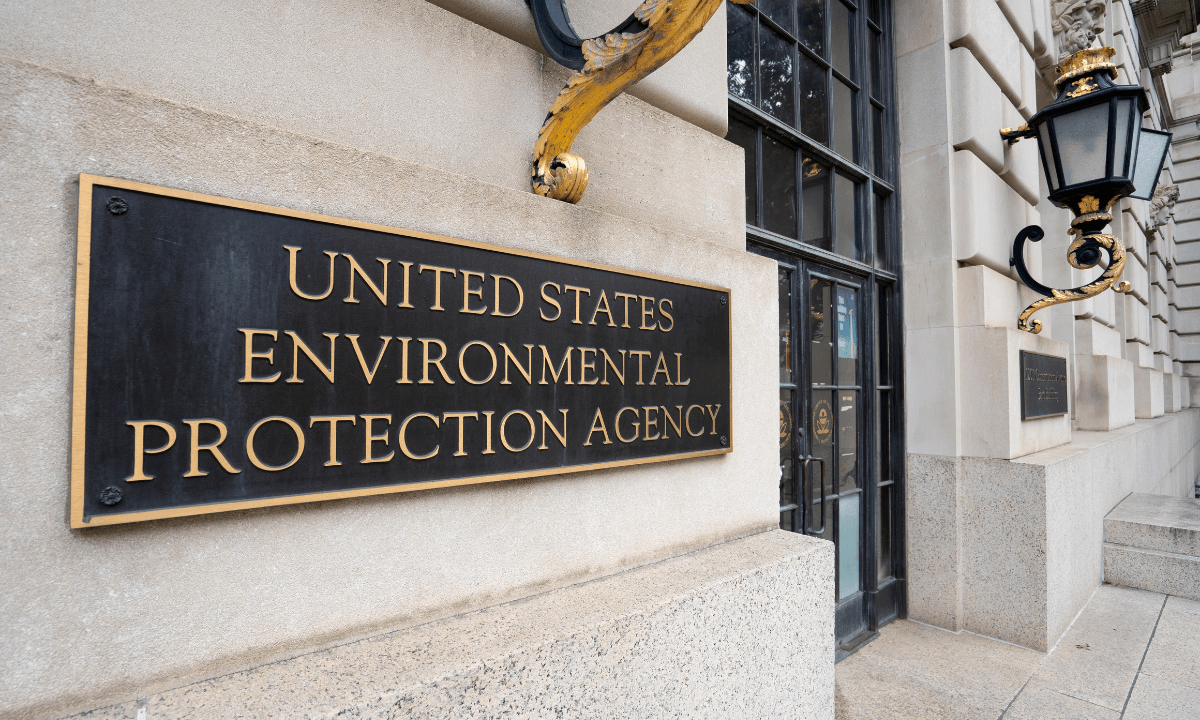
The U.S. Environmental Protection Agency (EPA) has announced a Proposed Rule 27 that would establish or update the conditions under which certain refrigerants, including hydrocarbons, would be allowed for new residential and light-commercial air-conditioning and heat pumps and other applications under the Significant New Alternatives Policy Program (SNAP).
SNAP, established more than 30 years ago under the Clean Air Act, allows the EPA to evaluate and approve substitutes for ozone-depleting substances and HFCs targeted by the American Innovation and Manufacturing Act (AIM).
EPA Administrator Lee Zeldin signed the proposed rule on October 24 and submitted it for publication in the Federal Register. A pre-publication version is available here, and a fact sheet is available here. EPA will accept comments for 45 days after the proposal is published in the Federal Register. Comments, identified by Docket ID No. EPA-HQ-OAR-2024-0503, may be submitted here. If requested, EPA will hold a virtual public hearing for the proposed action 15 days after publication of the proposal in the Federal Register.
The Proposed Rule 27 would update use conditions for eight refrigerants in new residential and light-commercial AC and heat pumps, including two hydrocarbons, propane (R290) and R441A (a blend of propane, butane, isobutane and ethane). The others are HFC-32 and five HFO blends incorporating HFO-1234yf.
Under the proposed rule, the EPA is taking comment on whether to finalize a use condition for these refrigerants consistent with UL Standard 60335-2-40, 4th edition, or one requiring certification by a Nationally Recognized Testing Laboratory (NRTL) listed by the U.S. Occupational Safety and Health Administration (OSHA). NRTLs listed by OSHA include UL, CSA Group Testing and Certification and Intertek.
The EPA generally refers to standards groups like UL and ASHRAE when accepting new refrigerants and applications. This also happens in concert with adoption by model and state building codes. Twenty-three states have passed legislation that would enable expanded use of hydrocarbons (in addition to A2Ls), once UL 60335-2-40 and ASHRAE 15 are updated and EPA SNAP-approved.
The proposed rule would also establish for the first time conditions for the use of HCR 4141 (a hydrocarbon blend), HFO-1234ze(E) and R-516 (an HFO blend) in new residential and light-commercial AC and heat pumps. For these refrigerants the EPA is also taking comment on whether to finalize a use condition consistent with UL Standard 60335-2-40, 4th edition, or one requiring certification by an NRTL.
“This proposal would help streamline the adoption of new equipment using ultra-low GWP refrigerants, including R290, while maintaining a robust process for ensuring safety.”
Christopher Douglass, Climate Policy Analyst, EIA US
The proposed rule includes other hydrocarbon applications. For example, it covers updated conditions for R290 in new water coolers, with the EPA taking comment on whether to finalize a use condition consistent with UL Standard 399, 8th edition, or one requiring certification by an NRTL. It also encompasses for the first time use conditions for HCR 4141 in new household refrigerators and freezers, with the EPA taking comment on whether to finalize a use condition consistent with UL Standard 60335-2-24, 3rd edition, or one requiring certification by an NRTL.
In addition, the proposed rule for the first time sets conditions for use of HFO-1234yf and different HFO blends in positive displacement and centrifugal chillers as well as new and retrofit motor vehicle air-conditioning for specified vehicles and for heavy-duty pickup trucks and vans, buses and trains.
The U.S. branch of the Environmental Investigation Agency (EIA), which has been promoting the adjustment of U.S. codes and standards to accommodate higher charges of R290 in HVAC applications, was encouraged by the release of Proposed Rule 27. “It’s good to see EPA’s continued work to get a SNAP 27 proposal out,” said Christopher Douglass, Climate Policy Analyst, EIA US. “It’s even better to see the consideration of an option for using refrigerants according to an NRTL certification rather than needing a new rulemaking for each specific updated edition of a safety standard.”
“This proposal would help streamline the adoption of new equipment using ultra-low GWP refrigerants, including R290, while maintaining a robust process for ensuring safety,” Douglass added.
Meanwhile, in another action, the EPA is pursuing a reconsideration of the Technology Transitions rule, including five- and six-year delays in the launch of new GWP limits for refrigerants used in supermarket and cold-storage refrigeration.
UL working on new HVAC standard
UL’s most recent (fourth) edition of the 60335-2-40 standard limits the use of R290 to 114g for all HVAC residential and light-commercial applications. The ASHRAE-15 standard also significantly restricts A3 refrigerant use in residential and commercial applications to less than 150g with any larger amount requiring approval by a local jurisdiction’s code officials.
By contrast, the latest version (edition 7) of the global IEC 60335-2-40 standard, approved in 2022 and used as a model by individual regions and countries, takes a much more generous view of R290 in HVAC. It allows up to 988g of R290 in HVAC units located indoors or connected to the indoor space, such as ductless split ACs or ducted central systems; these are subject to room size limits and other equipment design requirements. It also allows 4.94kg of R290 in outdoor/indirect systems such as air-to-water monobloc heat pumps, among other limits.
In early October, UL held the first meeting of a new Technical Harmonization Committee (THC) to develop the 5th Edition of UL 60335-2-40. Christina Starr, Senior Manager, Climate Campaign for the EIA US, who is on the committee, said on LinkedIn that it formed a working group on A3 (flammable) and A2 (mildly flammable) refrigerants “to consider proposals to enable safe use of R290 and other near-zero emissions next-generation refrigerants.” The committee is also considering a new proposal to look at safety requirements for expanded use of CO2 (R744) she added.
The North American Sustainable Refrigeration Council (NASRC), under a grant from the California Air Resources Board (CARB), recently solicited proposals from qualified third-party subcontractors to conduct a full risk assessment of residential monobloc air-to-water heat pumps (ATWHPs) using higher charges of A3 refrigerants, including R290, isobutane (R600a) and other hydrocarbon refrigerants.
According to the solicitation, the primary objective of this project is to support stakeholder groups responsible for developing product and application safety standards and building codes for the safe use of A3 refrigerants, justifying higher charge amounts. These groups include the ASHRAE Standing Standard Project Committee (SSPC) 15 and Subcommittee 15.2, UL and the International Electrotechnical Commission (IEC) 60335-2-40 Standard committee.
Last year the U.S. Department of Energy convened a working group with industry and other stakeholders that prioritized the need to fully understand the risks of A3 refrigerants in residential monobloc air-to-water heat pumps. To that end, two research and testing projects on A3 refrigerant safety are underway at Oak Ridge National Laboratory (ORNL). One project looks at self-contained heat pump and air-conditioning equipment including heat pump water heaters; a second project examines small- to medium-size commercial chillers.
ASHRAE looking at 15 standard
In 2023 ASHRAE’s SPCC Subcommittee 15.2 began considering a change to the ASHRAE 15 standard that would allow the use of up to 4.9kg of A3 refrigerants in outdoor (indirect) heat pumps and air conditioners (such as ATWHPs) in the U.S. This change would be dependent on research confirming the safety of the higher charge limit; to that end, in 2024 SPCC Subcommittee 15.2 formed a working group, which developed a “work statement” to do computational fluid dynamics (CFD) and verification testing under the direction of Xudong Wang, Vice President of Research at the Air-Conditioning, Heating and Refrigeration Institute (AHRI).
EIA US said in a new report that it supports full harmonization of U.S. standards on the use of A3 hydrocarbon refrigerants in HVAC equipment with the global standard IEC 60335-2-40. This could enable 78–88% of new air-conditioning and heat-pump equipment in the U.S. to transition to propane (R290) between 2030 and 2035, according to the EIA.
Full harmonization with IEC 60335-2-40 on the use of A3 refrigerants in HVAC would go well beyond what is currently underway in the U.S., which the EIA called “partial harmonization.” In its report the EIA pointed out that so far the partial harmonization proposals and research considering expanded A3 charge sizes leave the “majority of current system types not yet addressed or considered,” notably residential ducted systems, mini-split ACs and commercial packaged and rooftop units.
Michael Garry is the U.S-based Editor-at-Large for ATMOsphere, where he was previously Editor-in-Chief of the NaturalRefrigerants.com website. He has worked at ATMOsphere since 2014 and has covered natural refrigerants since 2006.