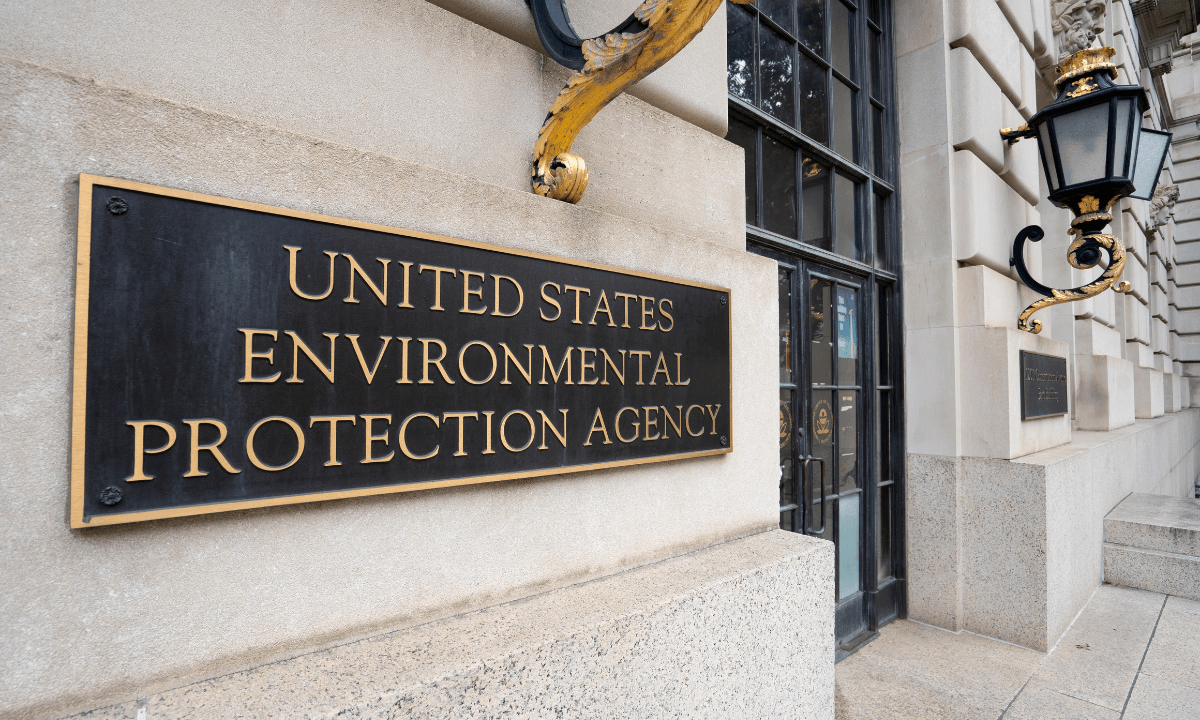
The 2025 Presidential Transition Project – known as Project 2025 – recommends in its section on the U.S. Environmental Protection Agency (EPA) that a potential future Republican administration repeal Biden-Harris administration HFC regulations authorized by the American Innovation and Manufacturing (AIM) Act “that are unnecessarily stringent and costly.”
Project 2025, an almost 900-page collection of policy proposals for a future Republican administration, was organized by the Heritage Foundation, a Washington, D.C.-based conservative think tank, and has been tied to Republican presidential candidate Donald Trump. He has distanced himself from the report but has personally met with the Heritage Foundation’s President, Kevin D. Roberts, and a Co-Founder, Edwin Feulner, and well over half of Project 2025’s 307 authors and contributors have been in Trump’s administration or on his campaign or transition teams, according to the New York Times.
The author of Project 2025’s EPA section, Mandy Gunasekara, served as Chief of Staff of the EPA during the Trump administration. She is currently Director at the Independent Women’s Forum’s Center on Energy and Conservation.
The campaign of the Democratic presidential candidate, Vice President Kamala Harris, has vigorously opposed the provisions of Project 2025.
The AIM Act, a bipartisan bill supported by the HVAC&R industry, was enacted on December 27, 2020 (during the Trump administration). It authorizes the EPA to phase down the production and import of HFCs, manage these HFCs and their substitutes, and facilitate the transition to next-generation technologies through sector-based restrictions. The EPA has finalized regulations for all three phases, most recently the management rule.
Project 2025’s EPA section did not indicate which regulations under the AIM Act it thought were unnecessarily stringent and costly. The section also urges that a Republican-led EPA, in implementing the AIM Act, “refrain from granting petitions from opportunistic manufacturers to add new restrictions that further skew the market toward costlier refrigerants and equipment,” without indicating which refrigerants and equipment were costlier.
The section also asks that the EPA “conduct realistic cost assessments” of the AIM Act “that reflect actual consumer experiences instead of the current unrealistic ones claiming that the program is virtually cost-free.” The EPA has disclosed that, in addition to the climate benefits from avoided emissions of HFCs, the Technology Transitions part of the AIM Act alone “provides up to $4.5 billion [€4.2 billion] in cost savings to consumers and businesses,” largely driven by the lower cost of HFC substitutes and increased energy efficiency of products using lower-GWP substitutes.
Other provisions of Project 2025’s EPA section related to the HVAC&R industry:
- If a new Risk Management Program (RMP) rule is finalized by the Biden-Harris administration, “it should be revised to reflect the amendments finalized in 2019 to protect sensitive information.”
- The designation of PFAS (per- and polyfluoroalkyl substances) as “hazardous substances” under CERCLA (the Comprehensive Environmental Response, Compensation and Liability Act), also known as Superfund, should be “revisited.”
The RMP requires end users of more than 10,000lbs (4,536kg) of ammonia (R717) to ensure a safe working environment. The Biden-Harris EPA announced finalized amendments to the RMP on March 1. In 2019, the Trump-Pence EPA rescinded parts of the RMP.
Long-chain PFAS like PFOA and PFOS have been linked to cancer and other serious health effects, and the Biden-Harris administration set aggressive new drinking water restrictions on these and other PFAS in April. However, the Biden-Harris EPA does not define f-gases like HFOs and their degradation product trifluoroacetic acid (TFA) as PFAS, though scientists believe it should, and the EU defines PFAS to include f-gases and TFA. The state of Minnesota, under Governor (and Harris’s vice-presidential running mate) Tim Walz, defines TFA to include f-gases and TFA.
The Heritage Foundation did not respond to inquiries about Project 2025’s EPA section.
Harris vs. Trump on climate, energy
The presidential election in the U.S., set for November 5 with early voting already taking place, presents a stark contrast between the candidates on climate, energy and pollution. Here is a summary of where each stands.
According to her website, Harris, if elected, intends to:
- Tackle the climate crisis.
- Advance environmental justice, protect public lands and public health, increase resilience to climate disasters, lower household energy costs, create millions of new jobs and continues to hold polluters accountable.
- Continue and build upon U.S. international climate leadership. The Biden-Harris administration rejoined the Paris climate agreement after the Trump-Pence administration withdrew from it.
Harris can be expected to maintain Biden-Harris administration’s Inflation Reduction Act (IRA), which includes:
- Tax credits to incentivize household electrification by lowering the total cost of qualified electrification upgrades such as air-source heat pumps, heat pump water heaters and geothermal heat pumps.
- For contractors, $200 million (€185.3 million) in electrification and energy efficiency training grants, as well as incentives per qualifying electrification (up to $500/€463) and per qualifying energy efficiency project ($200/€185).
- For heat pump manufacturers, a $10-billion (€9.3-billion) clean energy manufacturing tax credit, which will drive down the overall cost of domestic clean manufacturing — including heat pump manufacturing — by cutting capital costs. The IRA also appropriates $500 million (€463.2 million) to the Defense Production Act, to fund, among other things, domestic heat pump manufacturing.
According to his website, Trump, if elected, intends to:
- Unleash the production of domestic fossil-fuel energy resources.
- Promote energy security.
- Eliminate the Green New Deal.
Trump has vowed to rescind unspent funds earmarked for climate provisions contained in the IRA, according to many media reports.
Trump can be expected to pursue policies adopted during the Trump-Pence administration, including:
- Withdraw again from the Paris climate accord. Trump has long rejected climate science, sometimes calling global warming a “hoax,” according to the Washington Post.
- Reduce EPA regulations. The Trump-Pence administration dismantled major climate policies and rolled back many more 100 rules governing clean air, water, wildlife and toxic chemicals, according to the New York Times.
“Refrain from granting petitions from opportunistic manufacturers to add new restrictions that further skew the market toward costlier refrigerants and equipment.”
Project 2025