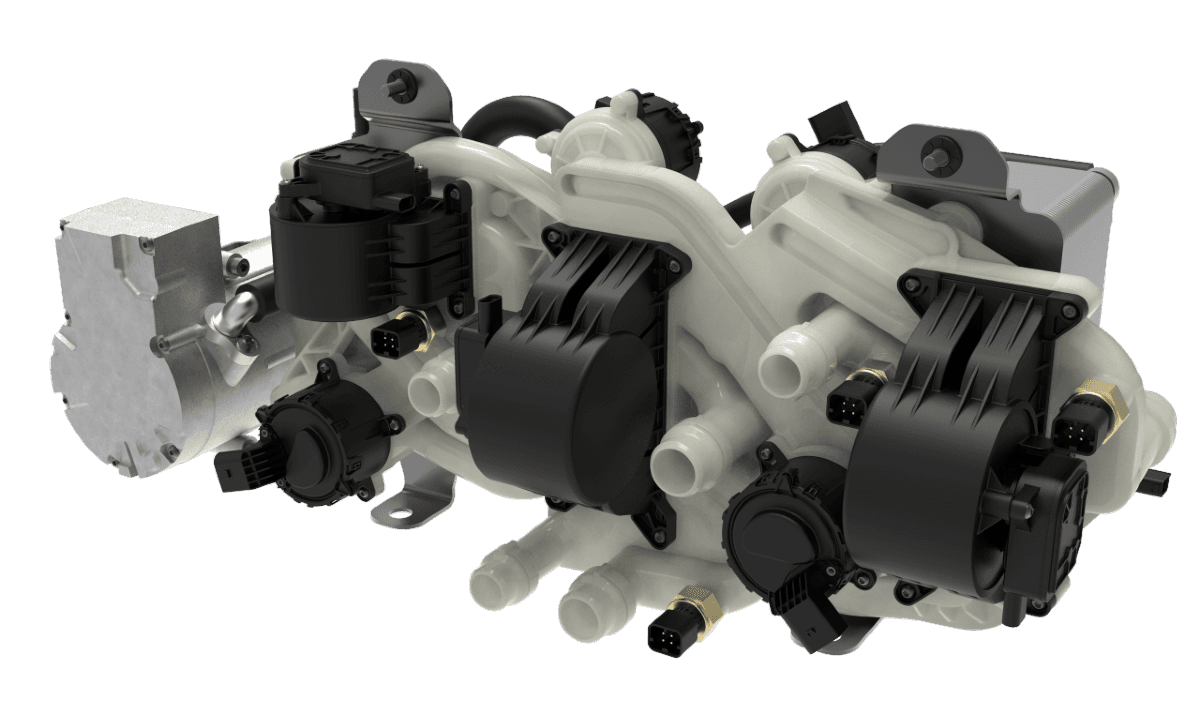
Sanden has announced that it is co-developing a propane (R290)-based integrated thermal management system (ITMS) for electric vehicles (EVs) with a “major” Chinese automaker.
The Japanese company, which manufactures automotive thermal management systems, did not name the Chinese company it is partnering with. It did say that this is its first ITMS co-developed with a partner in the country, however, and that the project’s goal is to “establish technologies compatible with next-generation refrigerants while preparing for future mass production.”
Sanden’s system uses an indirect setup with separate coolant and refrigerant circuits. The design is popular in mobile air-conditioning (MAC) systems for electric vehicles as it keeps propane out of the cabin.
“By working closely with the customer, Sanden efficiently conducts specification studies and technical validation that reflect market requirements, leading to concrete development phases toward future mass production and business acquisition,” Sanden said in a press release.
The work continues: Sanden has been working with natural refrigerants in MAC since the mid-2010s.
- The company developed a mechanical compressor using CO2 (R744) for MAC systems, which it began supplying to Daimler in 2017. By 2018 more than 40,000 Daimler vehicles, including the Mercedes-Benz S-Class, were equipped with the CO2 compressor.
- At the time Sanden spoke about how electric cars will drive the update of CO2 MAC systems.
- Automotive thermal management supplier Hanon Systems said it had supplied more than 1 million CO2 e-compressors for electric vehicles manufactured by Volkswagen as of September 2025.
China leads the way: China has emerged as a major hub in the development of natural refrigerant-based MAC systems for EVs.
- Shanghai Highly, Midea Welling Auto Parts and Megmeet were a few of the Chinese companies showing off components for R290-based EV MAC systems at Auto Shanghai 2025. Chinese automakers Dongfeng and China Changan Automobile Group also exhibited R290 MAC components.
- Government regulations and the country’s booming EV sector are driving the shift. China finalized a regulation last year to ban the use of refrigerants in new cars with a GWP greater than 150 beginning July 2029, which also stated that the government will “encourage research and application of natural refrigerant alternatives in electric vehicle thermal systems.”
Outside of China, American automaker Ford has emerged as a proponent of R290 MAC systems for electric vehicles. Angelo Patti, Product Development Engineer at Ford, said, “R290 is the best global option for BEVs if safety is addressed” during a presentation at the ATMOsphere (ATMO) MAC Summit 2024 × TU Berlin. ATMOsphere is the publisher of NaturalRefrigerants.com.