This is an excerpt from an article featured in ATMOsphere’s “Clean Cooling for Data Centers 2025” report, which can be downloaded here. ATMOsphere is the publisher of NaturalRefrigerants.com.
Alfa Laval is a global manufacturer of heat transfer, separation and fluid-handling solutions headquartered in Lund, Sweden. It was founded in 1883 and originally manufactured milk separators, with its first heat exchanger produced in 1938. Today Alfa Laval has more than 30 manufacturing sites across the globe and 22,000 employees.
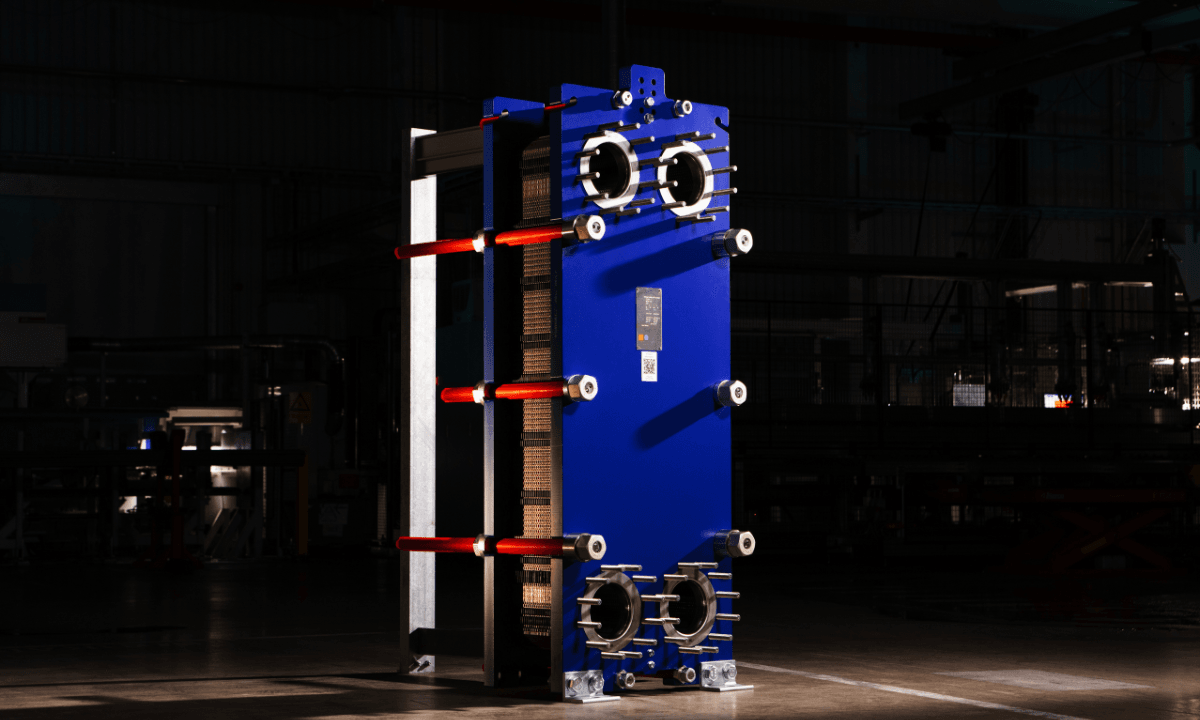
Its HVAC&R portfolio includes gasketed plate heat exchangers and brazed plate heat exchangers (BPHE). The company has worked in the data center sector for 20 years, according to Anna Blomborg, the company’s Head of Data Centers. Since then the segment has grown in lockstep with the sector’s rapid expansion, Blomborg said, adding that “the outlook remains strong.”
“The forecasts we’re seeing are extraordinary – some volume projections seem almost unrealistic,” Blomborg said. “Even after applying conservative adjustments, the numbers remain impressive. This level of potential has us energized and committed to investing for growth.”
Heat exchangers for data centers
Alfa Laval first began supplying data centers with large gasketed plate heat exchangers that enabled evaporative cooling and free cooling using ocean or freshwater. Alongside them, the company’s brazed plate heat exchangers found their place in chillers, heat pumps and heat reuse connections.
It moved into the white space in 2022 when it first introduced compact BPHEs for coolant distribution units (CDUs) in liquid-cooled environments. Its first project was for a crypto mining operation in the United States with a single-phase immersion cooling system.
“The crypto industry was early in the adoption of liquid cooling,” Blomborg said. “Their compute density was far higher than traditional workloads, so they pushed for technologies like immersion cooling.”
Since then the industry’s focus has shifted toward single phase direct-to-chip cooling systems, a technology now generating significant buzz, Blomborg noted. “Two-phase direct-to-chip cooling and immersion are alternative solutions that we are monitoring very closely,” Blomborg said.
The company is actively tracking the rapid evolution of coolant distribution units and recently released an extra-large brazed plate heat exchanger engineered specifically for 2.5MW CDUs. This development marks a significant step forward in meeting the growing demand for high-capacity cooling solutions and also opens the door to new opportunities for Alfa Laval to innovate at scale, Blomborg said.
Increased involvement of end users
In recent years, the dynamic between data center operators and technology providers has shifted. Where Alfa Laval once primarily supplied OEMs building cooling skids or coolant distribution units, today hyperscalers and other end users are stepping forward to collaborate directly.
“We’re seeing a growing trend where the end user wants to be involved in the design process,” Blomborg said. “They’re looking at heat transfer solutions as a strategic lever for efficiency.”
This interest is driven by the relentless pursuit of better power usage effectiveness ratings. Even small improvements in heat exchanger design, down to a few degrees or tenths of a degree, can translate into massive energy savings across facilities operating hundreds of megawatts of IT power. “There’s a lot you can achieve through precision in heat exchanger design,” Blomborg said. “Those incremental gains matter when you scale.”