Tim Hannig, Founder and Managing Director of HYTING, spoke with NaturalRefrigerants.com about the company’s hydrogen catalytic air-heating system. He also discussed its potential for peak-demand shaving in industrial facilities and plans for scaling and global expansion.
The technology’s potential applications include process heating, auxiliary automotive heating and absorption cooling, producing air streams up to 300°C (572°F), Hannig told NaturalRefrigerants.com. However, due to limited hydrogen availability, HYTING is focusing on the most practical and economically viable market: the growing industrial space-heating sector.
“With the peak shaving, we can provide a positive business case to customers today, despite high hydrogen cost,” Hannig said. “The unit operates at 98% efficiency, with 1‒2% of the heat energy used for a valve, a fan and the electronics.”
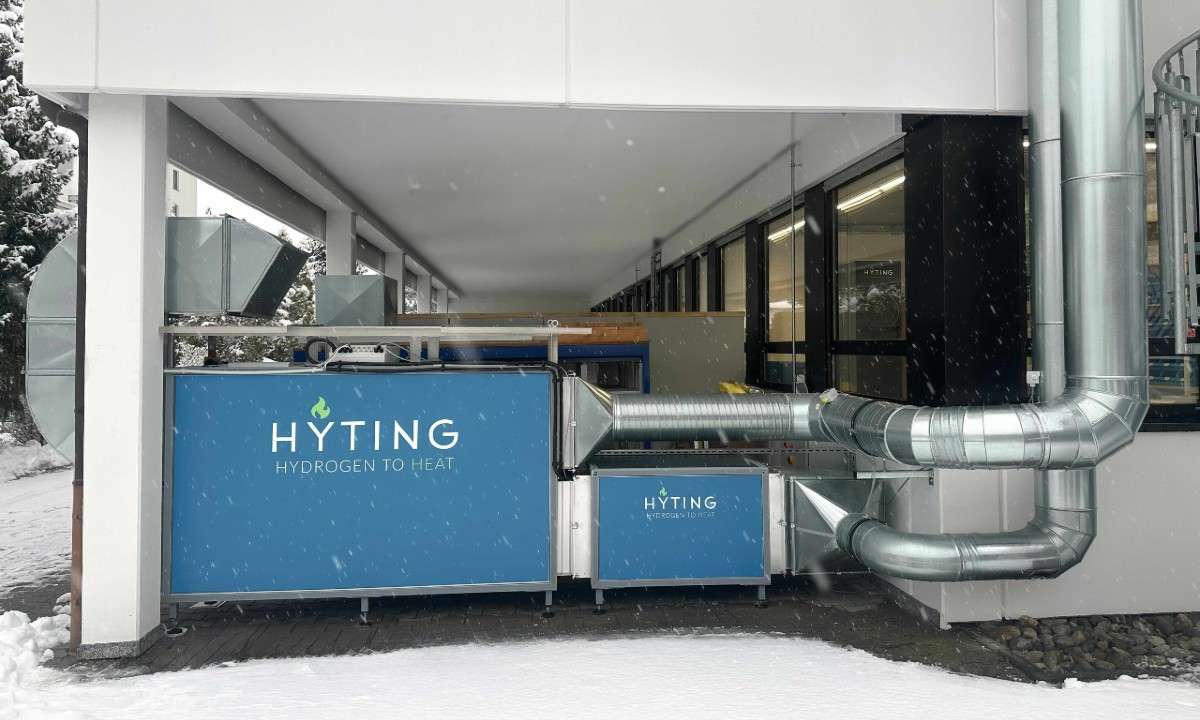
In February HYTING commissioned its first catalytic hydrogen air-heating system in a new industrial facility in Offenbach, Germany. Flusys, a producer of pumps and fluid systems for industrial applications, installed a hybrid heat pump/catalytic hydrogen system to heat its 1,000m3 (35,300ft3) production space, with the 10kW (2.8TR) HYTING unit supporting peak heating demand.
The interview has been edited for length and clarity.
How does the technology work? What about flammability?

Tim Hannig: It’s a simple process, with catalyzer technology developed since the 1970s. We mix hydrogen and air in a non-flammable concentration well below 4% [lower flammability limit]. We push the mixture through a catalytically coated core, where the hydrogen reacts with the oxygen in an exothermic process to generate low-humidity air at 300°C. At that temperature, it oxidizes everything, even carbon monoxide. It’s a super clean hot airstream that we mix in an air handler to produce the desired temperature.
For safety, we deliberately keep the hydrogen feed and the HYTING unit outside the building. That avoids flammable level accumulations, even in micro leaks.
What benefits does the technology offer? What market conditions factor into it?
TH: Our technology is not a heat pump competitor but a synergistic hybrid solution. Heat pumps operate efficiently at 40°F [4°C], but as it gets colder, COPs go down. Meeting the coldest ambient temperature heat loads requires exponentially bigger heat pumps, with only a third of the unit’s capacity used in 90% of its operation.
In Europe, the electrical connection price is based on the heat pump’s capacity. We cut that peak off. By sizing the heat pump for the capacity used 90% of the time, we lower CAPEX per kilowatt, while our hydrogen technology handles the coldest days. With the ability to modulate the unit’s output from 1 to 10kW [0.3 to 2.8TR], we control the inlet air temperature. Without a heat exchanger, nearly 100% of the generated heat goes directly into the building’s airflow.
What does production and deployment look like for HYTING? Any plans for marketing outside of Europe?
TH: Besides the unit already installed, we have three more in various stages of deployment, with two going into operation in March. Right now we offer 10 and 50kW [2.8 and 14.2TR] heating capacity units, with plans to scale to 300kW [85.3TR], especially as we see a significant opportunity for dehumidification in processing heat applications.
Using decarbonized electrical sources to achieve the required process temperatures can be difficult. Some innovative companies command a price premium for the sustainable production of their products. If end users are willing to pay a higher price, we can produce ultra-clean green heat.
We plan to build 30 hydrogen catalytic units this year, 50‒100 next year, and expect production to grow into the thousands within three to four years. With the units being manufactured by our industrialization partner ebm-papst, a German manufacturer of fans and heating technology, we can scale production as needed. We are focused on the European market, but with maturity, we expect to expand into new regions in 2027.
Beyond Europe, we see potential markets for the systems in Canada and areas in the U.S. where energy rates are high, particularly California, New Jersey and Texas. We are also exploring opportunities in Brazil, which has significant hydrogen activity, and in China, where hydrogen has been designated a key technology under the country’s five–year plan.
“With the peak shaving, we can provide a positive business case to customers today, despite high hydrogen cost.”
Tim Hannig, Founder and Managing Director of HYTING