In a survey of 28 supermarkets in Northern California, the Environmental Investigation Agency’s U.S. branch, Green America and YouthPower Climate Action found that half of the stores were “measurably leaking refrigerants” with high GWPs.
The investigation focused on stores operated in the Bay Area and Sacramento by Safeway (a subsidiary of Albertsons), Kroger-owned Ralphs Grocery and Food Co., Save Mart, Smart & Final and Walmart. The EIA reported the findings last month in a report, “Leaking Havoc in Northern California: Invisible Climate Pollution in the Golden State.” This is the NGO’s third “Leaking Havoc” survey, following similar studies of stores in 2023 in the New York City area and in 2021 in the Washington, D.C., area.
The California investigation discovered refrigerant leaks in 75% of the Save Mart stores and in half of the stores operated by Safeway, by Smart & Final and by Walmart. All of the stores were found to use high-GWP refrigerants, including R507, R407A, R-134a and R404A; at some Save Mart stores, ozone-depleting HCFC-22 was detected. According to the California Air Resources Board (CARB), 23 of the 24 stores in this investigation reported leaks in 2023, “suggesting chronic leaks,” said the EIA.
Albertsons and Walmart were ranked 10th and 8th, respectively, out of 16 major U.S. grocery chains that EIA assessed for their actions to reduce emissions of HFCs in 2024.
Safeway parent Albertsons, Smart & Final and Save Mart did not respond to a request for comment from NaturalRefrigerants.com on the EIA leak report. Walmart said it could not comment on the EIA study. EIA said it notified the surveyed companies prior to publication of the report to allow for comments but “no responses have been submitted at this time,” according to the report.
In its environmental, social and governance (ESG) Reporting on climate change, last updated December 15, 2023, Walmart said, “We are working to minimize refrigerant gas leakage through repairing and maintaining our existing equipment, as well as by working with industry-leading consultants to implement innovative solutions for reuse. Such efforts have resulted in an average leak rate across our U.S. store operations that is lower than the supermarket industry average stated by the U.S. Environmental Protection Agency (EPA).”
In addition, said Walmart, “Most of our facilities use higher-GWP systems prevalent at the time of initial construction. We have earmarked significant capex towards replacing refrigeration equipment as it ages and is retired from service with lower GWP alternatives (including ultra-low GWP systems), and installing low-GWP systems in new builds where commercially available. In the United States, we now operate more than 200 facilities that fully or in-part utilize ultra-low GWP refrigerants including carbon dioxide (CO2), glycol and ammonia.” Walmart added that it has a goal of zero emissions by 2040.
In its 2023 ESG report, Albertsons said, “As part of our Climate Action strategy, we have developed a roadmap to reduce our refrigerant leakage rate and convert to lower global warming potential refrigerants in our operations. We have committed capital to these projects and are working with our operating divisions to ensure we drive execution in support of local, state, and national refrigerant goals and requirements. In 2022, we completed more than 85 projects to transition stores to lower global warming potential refrigerants. We also currently have 3 stores that utilize carbon dioxide (CO₂) refrigerant systems, with plans to further expand in the coming year.”
Closed cases tested
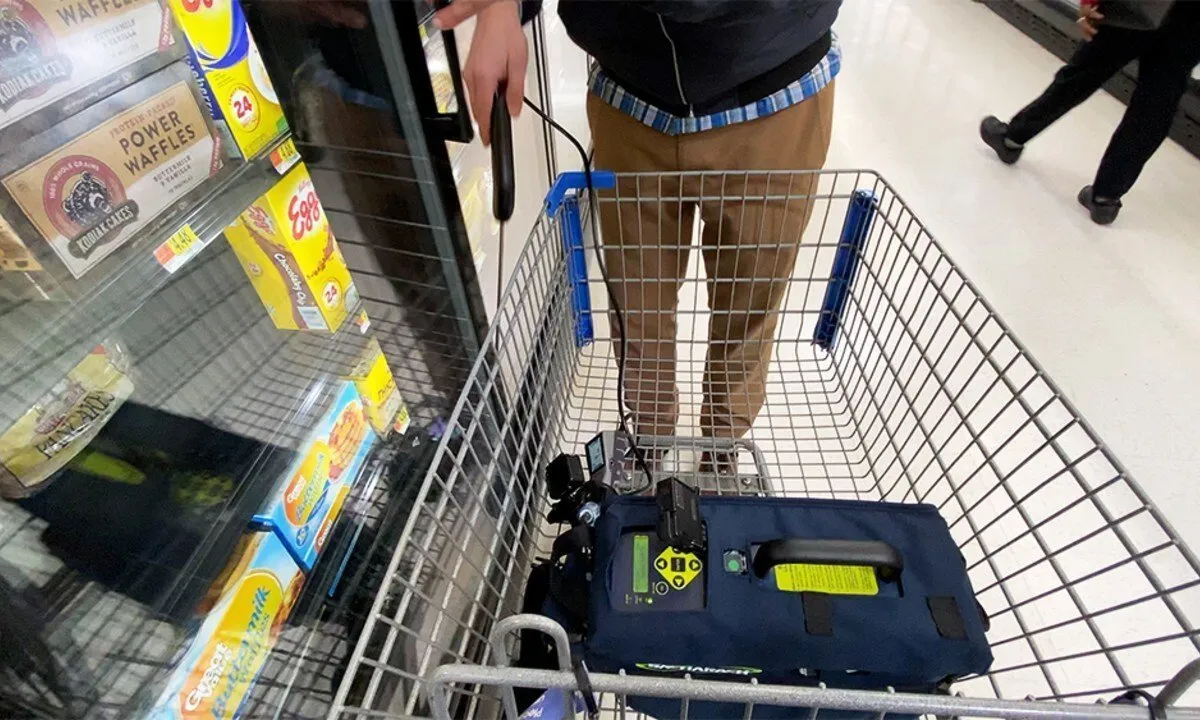
The EIA, NGO Green America and trained volunteers from the YouthPower Climate Action visited the 28 stores in the spring of 2024. Using the same portable leak detector (the Bacharach PGM-IR Bagless Portable Refrigerant Monitor) employed in its earlier investigations, the teams inspected each store’s retail area for refrigerant leaks. The EIA said it primarily tested for leaks near the ground in closed display cases “where refrigerants likely are contained and settled.”
The EIA documented the concentration detected by the equipment in parts per million (ppm), targeting the refrigerant listed in the display case. All concentrations detected above 2ppm (above 10ppm for HCFC-22) were considered an indicator of a “potential significant leak” in a given store, said EIA, adding that leaks were detected up to 60ppm in Save Mart stores.
The EIA noted that the ppm recorded for each store “does not quantify the size and severity of a leak, which may vary based on the timing and location of the leak detected and the amount of dispersion.” Thus, the NGO decided to simply record whether a store had a leak or not, and not disclose specific ppms. “However, all leaks recorded using this procedure had the potential to be major leaks, even if detected at a small concentration of less than 10 ppm, given the likelihood of considerable dispersion throughout the large space,” added the EIA.
“All leaks recorded using this procedure had the potential to be major leaks, even if detected at a small concentration of less than 10ppm, given the likelihood of considerable dispersion throughout the large space.”
Environmental Investigation Agency
Since it was relying on the accuracy of refrigerant information in the cases, the EIA believes it “likely undercounted” the stores with leaks. “Additionally, our investigation took place on the publicly accessible store floor, and a majority of leaks occur in areas inaccessible to everyday customers and our investigators,” said the agency. “The potential problems at these stores are therefore much worse than our data shows.”
The EIA noted that Albertsons has a history of issues with refrigerant management, including two settlements with CARB. In 2021, the retailer settled for $5.1 million (€4.6 million) after failing to comply with CARB’s requirements on managing leaks and submitting leak reports; in 2023, Albertsons settled with CARB for $4,000 (€3,800) after failing to repair a refrigerant leak within the permitted time frame. Save Mart has settled three times with CARB for noncompliance in regard to leaks since 2015, with penalties between $150,000 (€143,000) to the most recent of nearly $1.6 million (€1.5 million) in May 2024, added the EIA.
Grocery chains across the U.S. will be required to meet stricter refrigerant management practices per the latest rule within the U.S. AIM Act finalized by the U.S. Environmental Protection Agency (EPA) in September. This Emissions Reduction and Reclamation (ER&R) program includes a comprehensive set of requirements targeting automatic leak detection, leak repairs and the use of reclaimed HFCs for maintenance and servicing.
Call for action
The EIA urged U.S. retailers to follow ALDI US in committing to using natural refrigerants across new and existing stores. In California, the F-gas Reduction Incentive Program (FRIP) funding is available to support the transition across supermarkets to natural refrigerants.
The EIA also recommended EPA’s GreenChill program, a voluntary partnership for the food retail industry to reduce refrigerant emissions and transition to the latest systems. None of the California companies investigated for leaks are part of GreenChill, except Ralphs Grocery, owned by Kroger, which is a GreenChill partner.
In addition, the EIA called on retailers to:
- Implement upgrades to leak monitoring and repair best practices, including a zero-leak tolerance policy that requires leaks to be repaired prior to adding more refrigerant, and leak detection systems set to trigger an alarm at 2ppm.
- Reduce corporate average refrigerant leak rate to EPA GreenChill best-in-class rate of less than 5% and publish progress towards this goal.
- Institute criteria to retire and replace chronically leaking systems exceeding a 25% leak rate.
- Develop a strategy to fully phase out all HFCs in stores by 2035, including an interim target to reduce HFC emissions by 50% by 2030.
- Immediately use only HFC-free refrigeration in all new builds and major retrofits.
- Use only recycled and reclaimed refrigerants to service existing equipment that uses HFCs.
The EIA urged federal and state regulators to:
- Increase resources for enforcement actions and consider increasing the fines to address repeat non-compliance by companies.
- Require retailers to attain a company-wide weighted-average GWP of less than 1,400 or a 55% or greater reduction in greenhouse gas emission potential (GHGp) below 2019 levels by 2030.
- Amend automatic leak detection system regulations to require an alarm at leaks detected above 2ppm for industrial refrigeration systems.
The EIA also encouraged shoppers to identify stores using high-GWP refrigerants and serve as a tool to hold companies accountable.