A sustainability upgrade at Ordos Ejin Horo Airport includes installing CO2 (R744)-based heating and cooling systems, aligning with the Civil Aviation Administration of China’s 2022 Green Development Policy and Action.
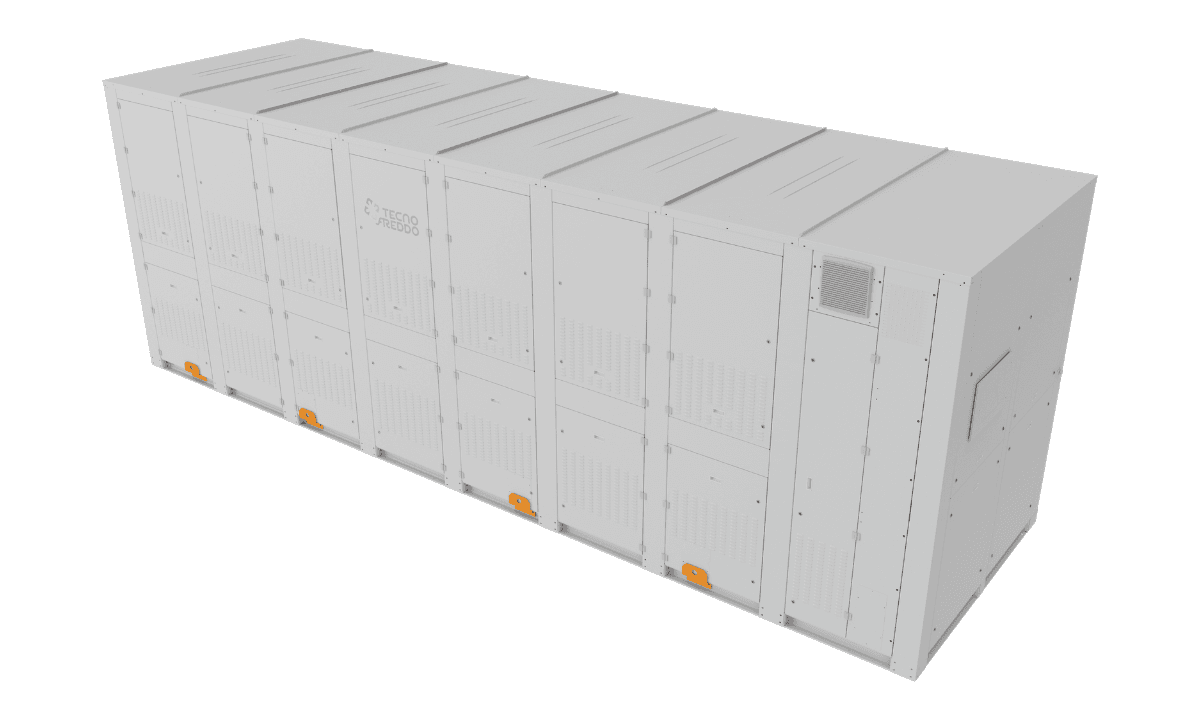
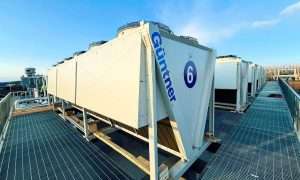
The project involves replacing fossil fuel boilers to heat an existing building and providing heating and cooling for a newly constructed building. Güntner, a German heat exchanger manufacturer, supplied 18 evaporators, each rated at 350kW (99.5TR) when operating in ambient temperatures of −12°C (10°F) with an evaporation temperature of −18°C (0°F), Zexuan Zhang, Senior Commercial and Industrial Refrigeration Manager at the company, told NaturalRefrigerants.com. Chinese manufacturer Haier Carrier supplied six transcritical CO2 heating and cooling units.
“The system delivers highly efficient seasonal climate control, demonstrating how smart thermal solutions can revolutionize energy use in large-scale public infrastructure,” Güntner said.
Additional details: CO2 units, housed in two equipment rooms, supply HVAC for the facility’s entire 18,000m2 (193,750ft2) footprint, which includes the terminal and surrounding buildings.
- Six Güntner evaporators heat the existing building.
- In the new building, 12 Güntner units support heating in the winter and cooling in the summer, with simultaneous operation technically feasible.
Decarbonization results: Peking University led the Ordos zero-carbon airport project, with local photovoltaic power generation providing all the energy for the CO2 HVAC systems.
- The CO2 heating/cooling installation cuts the airport’s carbon emissions by 5,500 metric tons per year and reduces electricity consumption by 5.5 million kilowatt-hours annually, according to Güntner.
- “The research resulted in three major innovative achievements,” Peking University said. It developed the “world’s first” wide-temperature-range energy supply system for CO2 heating and cooling; the “world’s first” cross-seasonal energy storage and extraction system for CO2 HVAC; and an AI-powered platform that optimizes green electricity consumption throughout the year.
Haier Carrier news: The company recently completed China’s first automated production line for large-scale CO2 racks, with a 140bar (2,030psi) high-pressure explosion-proof test chamber.
- The new production line raises the company’s manufacturing capacity eightfold.
- For comfort heating and cooling, a newly opened AstraZeneca pharmaceutical complex with a total footprint of 54,000m2 (581,250ft2) in Qingdao, China, installed four dual-source HeatCO2OL heat pumps produced by Haier Carrier. The CO2 system, featuring 12 Güntner heat collectors alongside cooling towers manufactured by BAC, provides 5.2MW (1,478TR) of heating capacity and 950kW (270TR) of cooling.
Quotable: “Our institute’s zero-carbon airport project, developed over three years, has ultimately reached an internationally leading level,” Peking University said. “In the future, [we] will further improve the technology, accelerate its promotion, deepen cross-industry cooperation, and build zero-carbon communities, industrial parks, factories and mines.”
“The system delivers highly efficient seasonal climate control, demonstrating how smart thermal solutions can revolutionize energy use in large-scale public infrastructure.”
Güntner