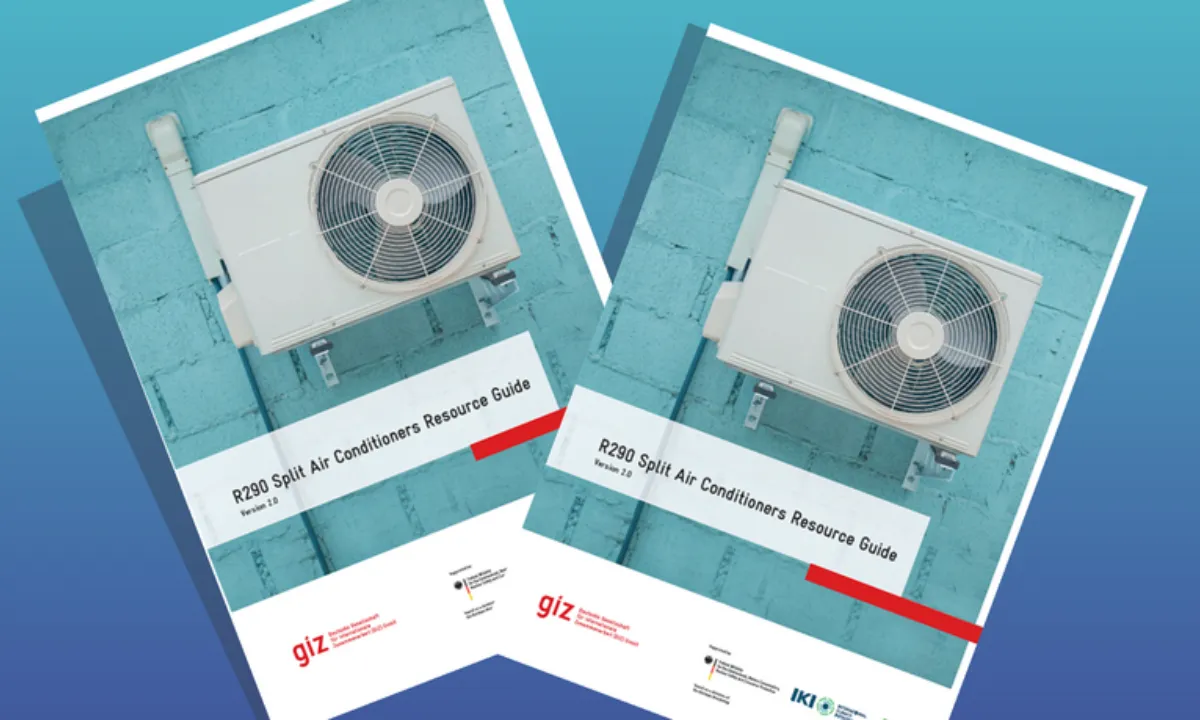
Together China and India have the capacity to produce up to 5.3 million propane (R290) split air-conditioning units per year, according to a recently published guide on R290 splits written by the GIZ (the German Society for International Cooperation).
The number of propane units currently produced is low compared to global sales, admitted Bettina Rechenberg, German Environmental Agency Director General of Division III ‒ Sustainable Production and Products of Waste Management. But she said that R290 is the “only viable and future-proof choice” for residential and light commercial applications when considering the phasedown of HFCs to adhere to climate protocols.
The GIZ forecasts that the number of split AC units on the market will go from just under 850 million to over 3.7 billion by 2050. Today’s split AC units generate around 1,800 metric tons of CO2e annually, with 700 metric tons resulting directly from refrigerant leakage.
If a business-as-usual (BAU) scenario plays out, the group predicts that total emissions will rise to 2,750 metric tons of CO2e annually by 2050, with 600 metric tons resulting directly from refrigerant leakage. “[However], a R290 split AC market share of 50% until 2050, may cut down total GHG emissions by 25% by 2050,” the GIZ said.
The group generated the resource guide based on interviews with industry players and experience gained from GIZ Proklima-supported projects to introduce R290 AC equipment in developing countries.
Rising production: “So far, the capacity to manufacture R290 split AC units is limited to China and India,” the GIZ said.
- China has the capacity to produce roughly 5 million R290 split AC units a year and 10 million R290 AC compressors. “Such units are now being marketed in Europe, and millions of portable/movable room AC units are being produced each year with R290,” according to the GIZ.
- In India, the GIZ assisted Godrej & Boyce in converting its split AC manufacturing from R22 to R290, with a production capacity of 300,000 units per year. The 5kW (1.4TR) capacity units follow the IEC 60335-2-40 standard, with a maximum 360g propane charge.
- “Other countries, like Egypt, Pakistan, Brazil, etc., are about to convert production lines under their stage II HCFC phaseout management plans of the Montreal Protocol,” the GIZ said.
Pilot projects: Under its Cool Contributions Fighting Climate Change (C4) Projects, the GIZ has funded the introduction of R290 splits along with technician training in Africa and Latin America.
- The group introduced 380 units to the market in Ghana. Midea and the GIZ jointly trained technicians from local AC dealers in safe installation, servicing and repair procedures.
- In Costa Rica, a project imported R290 units for demonstration and training, with installations in hotels and government buildings. “It will be indispensable for our country to know all the benefits of [R290] and to be trained in its use and applications,” said Marvin Donel Zuńiga Alvarez, Engineer at Ensayos Laboratory of Energy Efficiency.
Train the trainer: In the Philippines, a project is training 32 refrigeration and air-conditioning technicians on the safe and proper use of R290 splits.
- “The trainers will cascade what they have learned to their students in [technical education] training centers throughout the archipelago,” the GIZ said.
Quotable: “Accelerating the transition to more energy-efficient split ACs that use the natural refrigerant R290 can play a key role in creating a more sustainable RACHP [refrigeration, air-conditioning, heat pumps] sector,” the GIZ said. “[The R290 units] reduce the energy consumption and GHG emissions.”
A previous version of this article stated that China and India produce roughly 15.3 million R290 split ACs per year. That information was incorrect and this article has been updated to accurately reflect the information in the GIZ guide