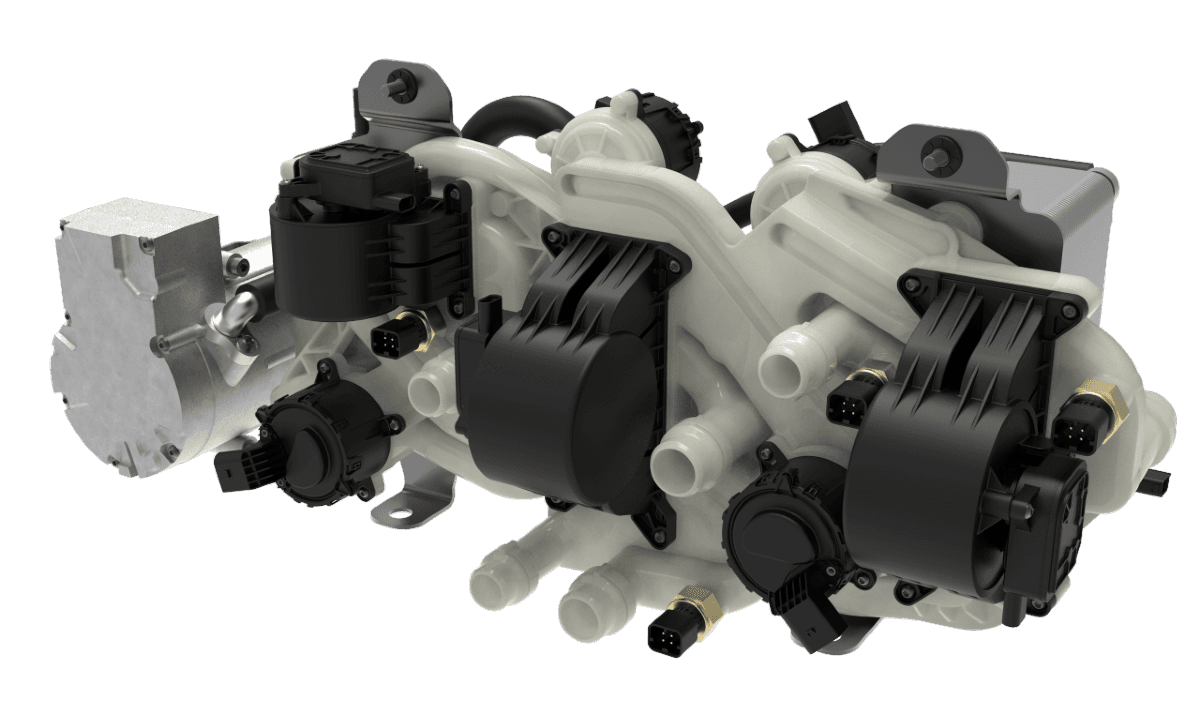
Ford Motor Company’s latest research has identified propane (R290)-based full-secondary loop heat pumps as a superior solution for battery electric vehicles (BEVs) that improves both HVAC performance and vehicle charging efficiency compared to traditional direct expansion (DX) systems, according to Angelo Patti, Product Development Engineer at Ford.
As the shift to BEVs accelerates, manufacturers face new challenges, including managing how ambient temperatures and thermal systems impact an EV’s driving range. To address these issues, Ford has tested three types of thermal management systems: air-to-air DX, water-to-water semi-secondary loop and water-to-water full-secondary loop systems. Of these, the full-secondary loop system has emerged as the top contender, offering significant performance benefits.
Environmental regulations, such as the recently revised EU F-gas Regulation and the proposed restrictions on per- and polyfluoroalkyl substances (PFAS), are also pushing automakers to explore more sustainable refrigerants. In this context, Ford’s research suggests that R290 is the ideal candidate.
“R290 is the best global option for BEVs if safety is addressed,” said Patti during his keynote at the ATMOsphere (ATMO) MAC Summit 2024 × TU Berlin.
“Refrigerants used today are not ideal from a thermal standpoint,” he added. “Typically, their boiling points are too high to accommodate the heat pump temperature range. R290, however, has properties that are much closer to the ideal target.”
He emphasized that Ford is seeking a global thermal solution, and R290 appears to be the best fit for the company’s BEV thermal strategy.
“R290 is the best global option for BEVs if safety is addressed.”
Angelo Patti, Product Development Engineer at Ford
Patti delivered his keynote alongside Dr. Werner Hünemörder, Senior Technical Manager of Advanced Systems R&D at DENSO, a key partner in developing propane-based full-secondary loop heat pumps for Ford’s BEVs. Together, they explored the performance advantages of these systems over conventional DX systems, including the benefits of R290 over R1234yf, a refrigerant widely used in mobile air-conditioning (MAC) systems in BEVs.
The ATMO MAC Summit 2024 × TU Berlin was organized by ATMOsphere, publisher of NaturalRefrigerants.com, and Technische Universität (TU) Berlin’s Department of Heat Transfer and Heat Conversion. It was the first ATMOsphere event dedicated solely to air-conditioning and heat pump systems for mobile applications and was held September 12–13 at the university’s campus.
Secondary loop vs. direct expansion
In BEVs, direct expansion systems cool or heat the cabin by circulating refrigerant directly through the HVAC system. This approach is generally simpler but requires a high-voltage heater to meet heating demand in colder temperatures, affecting system efficiency, and results in complexities with refrigerant control. It also requires a separate loop to cool the vehicle’s battery, Patti explained.
In contrast, full-secondary loop systems use the refrigerant in a closed loop to transfer heat to a secondary fluid, which then heats or cools the cabin and battery. All components can be integrated into a module that fully contains the refrigerant circuit, which reduces the refrigerant charge by around 25% and system footprint by around 20%, he added. However, overcoming the thermal resistance of the secondary loop is a challenge. To address this, Ford has introduced vapor injection technology to improve efficiency.
Ford and DENSO’s testing showed that an R1234yf-based full-secondary loop heat pump with a vapor injector is 20% more efficient than a direct expansion system using the same refrigerant. This efficiency boost was observed in both heating and cooling modes, explained Hünemörder. A significant portion of the efficiency gains in heating mode came from the elimination of the high-voltage heater.
R290 vs. R1234yf
Ford and DENSO’s testing also showed that replacing R1234yf with R290 in a full-secondary loop heat pump improves system efficiency by 5% in heating mode and 29% in cooling mode. Propane also significantly reduced compressor speed dramatically.
In addition to efficiency savings, R290 enables fast charging due to its ability to maintain battery temperature. It also has an ultra-low GWP and is PFAS-free.
However, work is needed to overcome the flammability risks associated with propane. Ford is exploring several safety measures, such as leak detection and reduction, and controlling leak concentrations. According to Patti, if the refrigerant charge is kept below 150–200g, the flammability risk is significantly reduced. Other strategies include segmenting the refrigerant module to limit leaks and using the heat exchanger fan to disperse leaked refrigerant.
Ford plans to submit a proposal to the U.S. Environmental Protection Agency (EPA) to use R290 in automotive heat pumps and will begin bench and vehicle development by 2025, he explained.
The EPA had previously advised against the use of propane in MAC applications. In June 2023, German technology company ZF presented a new electric-drive system with a propane heat pump. However, since then, no carmaker has announced a plan to adopt R290 for MAC systems.
During his presentation, Patti noted the importance of industry collaboration to establish safety standards and operational procedures for global adoption of R290-based HVAC systems in BEVs.