European private equity firm Triton has emphasized the rising strategic importance of HVAC&R companies developing data center cooling product portfolios as global demand for data processing and digital infrastructure continues to accelerate.
“The growth of data centers in the world is just phenomenal, and the need for cooling is going to be unbelievable, particularly clean cooling,” said Ted Amyuni, Senior Industry Expert at Triton Partners. “It’s a good time to have a product category for data centers.”
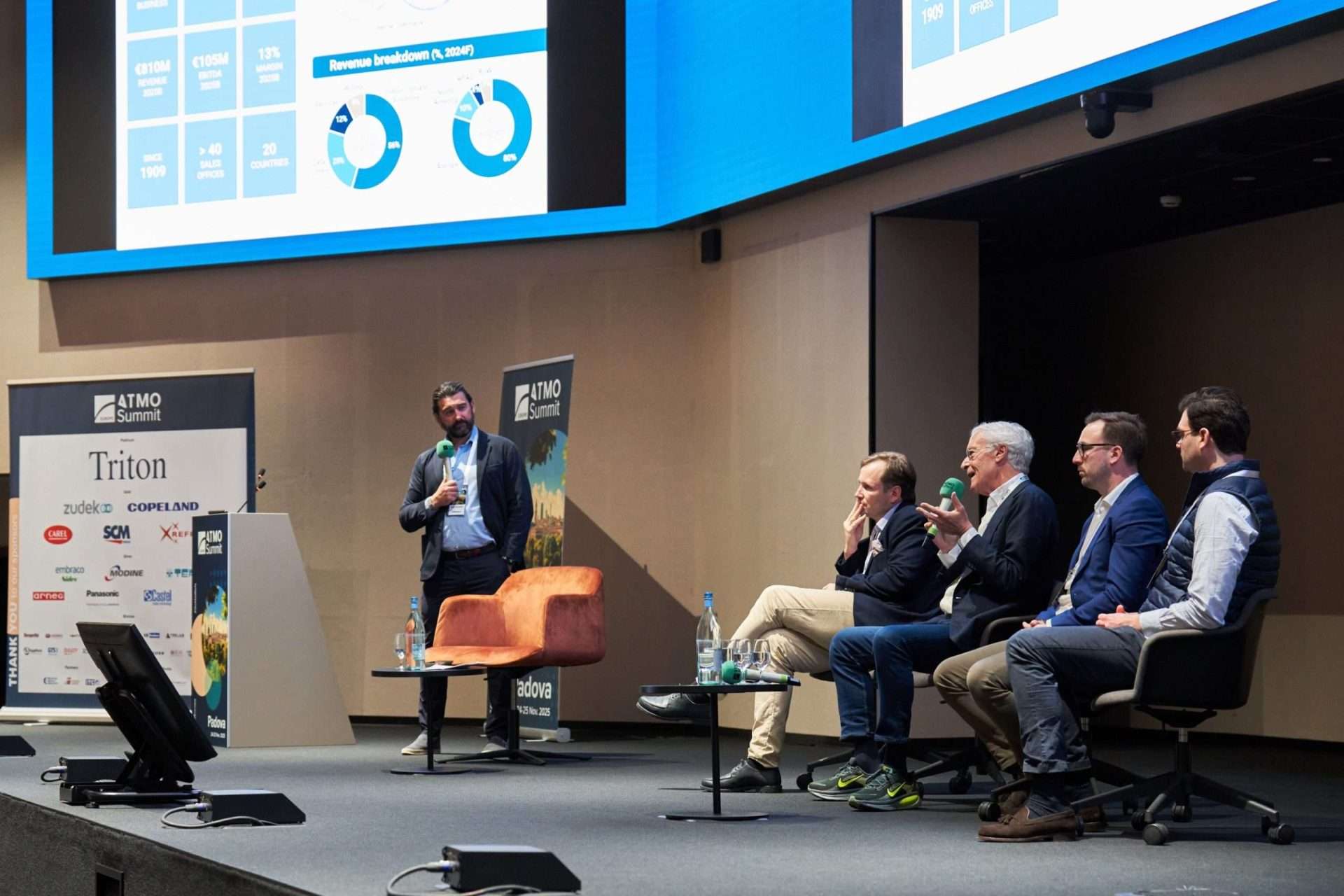
Amyuni delivered these remarks during the investor panel at the ATMO Europe 2025 Summit. He was joined by Friedrich Ysenburg, Investment Professional at Triton Partners; Timo Kivilaht, Senior Vice President of Global Sales and Solutions at heat exchanger manufacturer Kelvion; and Nicolo Freyberg, Managing Director of bluu unit, a contractor alliance focused on natural refrigerants. Both Kelvion and bluu unit are part of Triton’s HVAC&R investment portfolio.
During the panel, participants also underscored the need to build technical capacity to support the transition to natural refrigerants – a core priority for Triton – and the growing investment risks linked to PFAS (per- and polyfluoroalkyl substances).
ATMO Europe 2025 took place November 24–25 in Padova, Italy, and was organized by ATMOsphere, publisher of NaturalRefrigerants.com. Triton – a firm with more than 45 portfolio companies and a combined turnover of more than €18 billion ($20.8 billion) – was the event’s platinum sponsor.
“The growth of data centers in the world is just phenomenal, and the need for cooling is going to be unbelievable, particularly clean cooling. It’s a good time to have a product category for data centers.”
Ted Amyuni, Senior Industry Expert at Triton Partners
Data centers
Commercial HVAC equipment manufacturer FläktGroup – which Triton recently sold to Samsung – was highlighted by Amyuni as a clear example of the value embedded in data center cooling. When Triton purchased FläktGroup, the company had no offerings for data center applications and was concentrated almost entirely on indoor climate solutions, which accounted for roughly 80% of its business, he noted. By the time Triton exited, data center solutions had grown to about 25% of the company’s portfolio.
“We started a data center vertical from the ground up, adding big value to FläktGroup,” Amyuni said. “Samsung wanted to acquire FläktGroup to get into commercial HVAC and, most importantly, data centers. That exit was very successful.”
“We do a lot of research to really understand the opportunities,” added Ysenburg. “You need to differentiate yourself and talk about value creation in terms of really how we are going to improve companies. [Our companies] are very successful because we’ve been early on investing in [the sustainable cooling] space, when many others didn’t see it.”
In August, Triton sold a majority stake in Kelvion to U.S. private equity firm Apollo, maintaining a minority interest in the manufacturer. Kelvion has placed an increased focus on data center cooling solutions in recent years, which have become the company’s largest and fastest-growing segment, accounting for 50% of its €1.6 billion ($1.85 billion) order intake in 2024, according to Kivilaht.
“Data centers are clearly one of the biggest growth drivers over the last eight years, and [this trend] is going to continue over the next couple of years with a lot of investments,” Kivilaht noted. In addition to the development of larger data centers, solutions will also be needed for existing facilities that will have to be upgraded and expanded over the coming years to meet demand.
To prepare for the future, Kivilaht said, Kelvion has expanded its production sites in the U.S. It is also building an R&D center in the U.K. that is focused on the development and testing of new cooling solutions for data centers.
“We can actually test whatever kind of equipment is going into a data center to really figure out what’s going to be the right cooling solution,” he explained.
Amyuni noted a growing trend of large companies acquiring smaller firms and startups that specialize in liquid cooling technologies for data centers, something that was not as common a few years ago.
“Data centers are clearly one of the biggest growth drivers over the last eight years, and [this trend] is going to continue over the next couple of years with a lot of investments.”
Timo Kivilaht, Senior Vice President of Global Sales and Solutions at Kelvion
Building technical capacity
Another major theme of the investor panel was the urgent need to expand technical capacity across Europe to support the shift toward natural refrigerants, particularly with regulatory tailwinds helping to drive the transition.
Bluu unit was founded by Triton in 2023 following their acquisition of a majority stake in Germany-based Kälte Eckert Group, with the aim of creating a leading alliance of HVAC&R contractors for natural refrigerant-based projects in Europe.
“When we started, the market was in a very different position than it’s today,” Freyberg explained. “The EU F-gas Regulation was just about to be run through the EU legislation, and PFAS was known but not as apparent as today. There was clear potential, and we believe the market potential is so big.”
“We have a lot of good competitors in the technical building market, but no one is as focused on natural refrigerants,” he added. “When companies join bluu unit, they are not 100% natural refrigerants yet, but they need to have the clear understanding that this is the way forward – that’s where the market is going.”
Since its inception, bluu unit has entered the Swiss market and now consists of more than 27 contractors that collectively employ more than 900 people. In addition to its Swiss expansion, the alliance eventually plans to expand outside Germany, Switzerland and Austria. Over the last two years, Bluu unit has generated over €240 million ($278 million) in sales and completed more than 10,000 projects, according to Freyberg.
Core parts of bluu unit’s work are training, knowledge transfer and collaboration.
“We train with our suppliers as a group,” he noted. “We invite other companies that are not that advanced [in natural refrigerants] to send their people to work together on projects to help get them equipped with the right skillset.”
“When companies join bluu unit, they are not 100% natural refrigerants yet, but they need to have the clear understanding that this is the way forward – that’s where the market is going.”
Nicolo Freyberg, Managing Director of bluu unit
PFAS
PFAS regulation is another major trend that Triton is monitoring closely, both as a potential investment risk and as a catalyst for innovation, explained Ysenburg.
“When things change – like when PFAS regulation comes into place – there’s a lot of capital needed to foster that change,” he noted. “On the risk-management side, we have PFAS audits where we look into the exposure of our companies and try to handle that.”
Freyberg echoed the view that PFAS restrictions, while challenging, are also creating significant market opportunities. However, he stressed the importance of pacing the transition.
“Everyone has a clear state of mind about the impact [of PFAS], and, in the long term, I only see it as an opportunity for us that creates market growth and change,” he said. “But we need to find a balance here of not moving too quickly because you might lose people that are still quite overwhelmed by natural refrigerants.”
Kivilaht pointed to developments in China as further evidence of how rapidly PFAS-related changes may unfold, noting that China’s HVAC&R sector is already moving quickly on PFAS compliance. In his view both China and Europe are positioned to move far ahead of other regions, including the U.S. and Asia–Pacific, in adapting to PFAS regulations and advancing cleaner cooling technologies.
“Everyone has a clear state of mind about the impact [of PFAS], and, in the long term, I only see it as an opportunity for us that creates market growth and change.”
Nicolo Freyberg, Managing Director of bluu unit